
Do not buy a used EV from the dashboard range, a clean-looking vehicle-history report, or a seller saying the battery is “good.” Give the car a short safety walkaround and road-test it early.
If it survives, then do the deeper work: use the best battery evidence that exact model supports, prove the warranty and replacement history, and check charging against your real routes.
Unresolved high-voltage or battery questions go to an EV-capable specialist. If a mainstream car still carries a material compromise, I would rather walk and inspect the next one.
Last reviewed and rebuilt: September 8, 2026
What’s In This Guide
- The 5-minute screen before you drive
- Why I road-test it early
- Prove what car and battery you are buying
- How to check used-EV battery health without guessing
- Three EVs, three different proof paths
- How to verify battery warranty and replacement history
- How to verify charging compatibility
- When to call an EV-capable specialist
- The Used EV Proof Sheet
- When I walk away
Buying a used electric car deserves the same basic skepticism as any other used car, plus one extra layer: you are buying a high-voltage battery system, charging hardware, software support, and warranty history that can vary a lot by model and year.
That does not mean every used EV needs a laboratory inspection. It means you should stop pretending one shortcut works on every car. A Tesla battery-health result, a Nissan LEAF capacity gauge, and a Chevrolet Bolt recall-replacement record answer different questions.
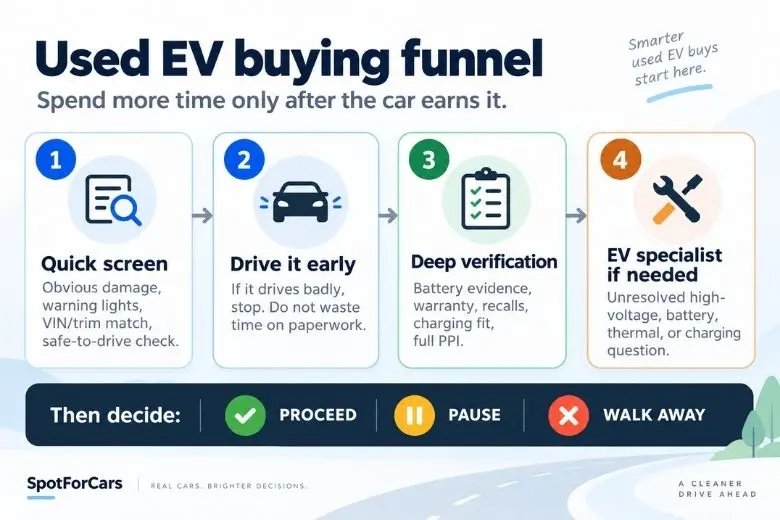
My process is simple: make the car earn your time. I do not spend an hour digging through records before I know whether the thing is even worth driving home.
What Should You Check in the First Five Minutes?
This first pass is not the full inspection. I want to know whether the candidate is obviously wrong, unsafe, misrepresented, or not worth any more of my time.
- Confirm the VIN, year, trim, mileage, and the battery/drive configuration match the listing.
- Look for obvious crash repair, major underbody or battery-area damage, flood or fire clues, and a badly damaged charge port.
- Check the dash for active battery, high-voltage, or thermal warnings.
- Make sure the tires and basic condition are safe enough for a road test.
- If the seller’s story already conflicts with the title, VIN, or major records, stop there.
For the normal body, suspension, tire, brake, fluid, and structural checks, use my used-car inspection guide. This page is only adding the EV-specific layer.
If you see meaningful battery-area damage, exposed high-voltage components, flood/fire evidence, or an active high-voltage warning, that is not an invitation to crawl deeper under the car. It is specialist territory.
Why Do I Road-Test a Used EV Early?
Because paperwork cannot rescue a car that drives like a piece of junk.
If the quick screen is safe enough to continue, I want the road test early. Listen with the radio off. Feel for abnormal vibration, suspension noise, wheel-bearing hum, steering problems, hard power limiting, warning messages, or anything that makes the car feel wrong.
Do not treat regenerative braking as a universal pass/fail test. Regen can change with state of charge, battery temperature, settings, software, and the exact model. The road test tells you whether the car deserves deeper work; it does not certify the battery.
My full used-car test-drive checklist covers the general driving sequence. On an EV, you are adding battery/thermal warnings, charging behavior when practical, and model-specific power or regen behavior.
“If the car already tells me on the road that I don’t want it, I’m not going to spend another hour trying to talk myself back into it.”
If It Drives Well, What Do You Verify Next?
Now the car has earned the deeper work. This is where I slow down and verify the story instead of shopping on emotion.
- Match the VIN, title/history, seller or dealer identity, exact trim, and battery configuration.
- Find the original in-service or delivery date needed to verify the applicable warranty clock.
- Get battery replacement, recall, campaign, and major service records when they exist.
- Use the best model-specific battery-health evidence the vehicle supports.
- Verify the charge port, adapter needs, software/hardware support, and the routes you actually plan to use.
- Run a full PPI after the candidate has survived the early triage.
A vehicle-history report helps, but it is not a mechanical certificate. The FTC says a vehicle-history report is not a substitute for an independent vehicle inspection.
Use the VIN and paperwork together with the actual car. My service-history guide explains how to cross-check records instead of trusting one report.
For recalls, use the NHTSA VIN lookup to see whether the car shows an unrepaired safety recall.
NHTSA also says the VIN search does not show recalls that were already repaired, some newly announced recalls before all affected VINs are identified, certain recalls older than 15 years, or manufacturer non-safety campaigns. That is why a battery-recall or replacement story may still require OEM or dealer records.
How Do You Check Battery Health on a Used EV?
Start with one rule: use the strongest evidence that exact car can actually provide.
I do not calculate battery health by charging the car to 100% and dividing the dashboard miles by the original EPA range. Range estimates move for reasons other than usable battery capacity.
Tesla’s own Model 3 warranty language calls vehicle range estimates an imperfect measure of battery capacity because other factors affect the estimate. Tesla states that limitation in the Model 3 warranty booklet.
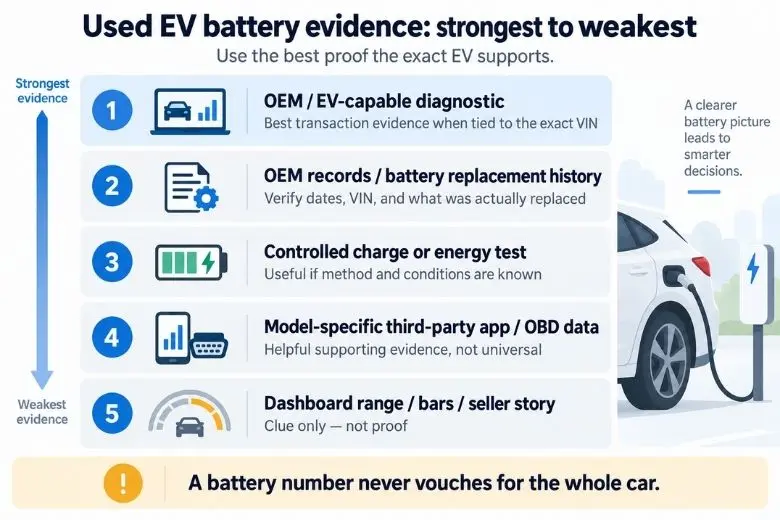
| Evidence | How I use it | Main limitation |
|---|---|---|
| OEM battery-health test or EV-capable dealer diagnostic | Best available transaction evidence when it is tied to the exact vehicle. | Every OEM defines and reports battery condition differently. |
| OEM/dealer BMS and battery records | Confirms battery history, replacement dates, campaigns, and sometimes health data. | Records can be incomplete or stale. |
| Controlled charging/energy observation | Useful as a consistency check when state of charge, temperature, station behavior, and method are known. | Too many variables exist to turn one session into a universal health number. |
| Model-specific third-party OBD/app estimate | Supporting evidence when the tool is known to work on that exact model/version. | Support, calibration, and interpretation vary. |
| Dashboard range, bars, seller story | Clue or context only unless the OEM gives the display a defined warranty meaning. | Easy to overread; never a cross-brand SOH formula. |
From a mechanic and used-car buyer’s perspective, I don’t try to guess an EV battery’s health from the dashboard range. I want the best model-specific evidence the car can give me.
If a material battery question is still unresolved on a mainstream car, I would rather pause for an EV-capable specialist or move to another candidate. I am not inventing a discount just to make uncertainty feel okay.
Why Does Battery Proof Change by Model?
These three examples prove one thing: there is no honest universal “used EV battery test.” They come from manufacturer documentation, not cars I personally tested.
2022 Tesla Model 3 Long Range
On supported Model 3s, Tesla provides a Battery Health evaluation under Controls → Service → Battery Health. Tesla says the screen uses battery-management-system data and compares the car with expected retention for its battery type, age, and usage.
Some vehicles also offer a full Battery Health Test that can take up to 24 hours on an AC charger; Tesla says not every Model 3 has that test. Tesla documents the process here.
For the older Model 3 Long Range warranty family, Tesla’s warranty booklet lists battery and drive-unit coverage of 8 years or 120,000 miles, whichever comes first, with minimum 70% capacity retention during the warranty period.
Tesla also says its current warranty page is only general guidance and the warranty that applies to the specific vehicle is authoritative. See the Model 3 warranty booklet and Tesla’s current warranty guidance.
That 70% number is a Tesla warranty term. It is not my universal “buy above this, walk below this” rule.
2022 Nissan LEAF
Nissan uses a different system. The 2022 LEAF warranty covers capacity loss below nine segments on the battery-capacity gauge for 96 months or 100,000 miles, subject to the warranty terms.
Nissan says a qualifying capacity repair is intended to return the battery to nine or more segments and may use new, remanufactured, or factory-reconditioned components. It does not promise to restore all 12 segments. Read Nissan’s 2022 LEAF warranty booklet.
Nissan also calls for an EV Battery Usage Report every 12 months under both standard and severe driving conditions, and says the report can help evaluate battery health and identify issues. Nissan lists that schedule here.
Ten bars may be above Nissan’s warranty trigger, but it does not automatically mean the car fits your range needs. The warranty question and the buying decision are not the same thing.
2019 Chevrolet Bolt EV with a recall replacement battery
This one shows why battery replacement history matters. Chevrolet says new or refurbished propulsion batteries installed under the Bolt recall receive an 8-year/100,000-mile limited parts warranty that begins at the time of installation.
That can create a different battery-warranty clock from the car’s original in-service date. Chevrolet explains the recall-replacement coverage here.
So when a seller says, “the battery was replaced,” I want the repair order, campaign record, installation date, and the exact warranty that came with that work. A replacement claim without the paperwork is still just a claim.
Supported Model 3s can provide Tesla battery-health evidence, Nissan gives the LEAF a capacity-gauge warranty framework and battery usage reports, and a recall-era Bolt can have a replacement-battery warranty clock. Treating those as one universal SOH number would be fake precision.
How Do You Verify Battery Warranty and Replacement History?
Do not start with “EV batteries have an eight-year warranty.” Start with this VIN, this mileage, this in-service date, this battery, this repair history.
| Seller says | Ask for | If the proof falls apart |
|---|---|---|
| “The battery is still under warranty.” | VIN, mileage, in-service date, exact model/year warranty, OEM/app/dealer confirmation. | Do not assign value to coverage you cannot prove. |
| “The battery was replaced.” | Repair order, recall/campaign record, install date, replacement-warranty terms. | Contradictory history gets OEM/dealer verification. A material uncorrected lie is a walk-away. |
| “There are no recalls.” | NHTSA VIN check plus OEM/dealer records when the campaign history changes battery, warranty, charging, or safety. | A “0 unrepaired recalls” result is not a complete repair history. |
This is also where a good service-history check earns its keep. Receipts, VIN-linked dealer records, recall completion, and battery work should tell the same story. If they do not, stop guessing.
How Do You Know a Used EV Will Charge Where You Need It?
Do not judge charging by the plug shape alone. Check the exact vehicle, adapter, software/hardware support, network rules, and the routes you actually drive.
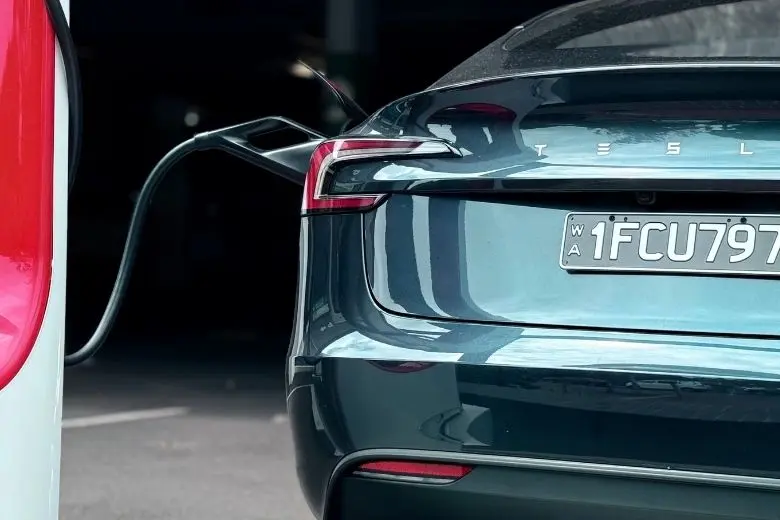
Tesla’s older Model 3 documentation says some cars can show Enabled, Not enabled, or Not compatible under Controls → Software → Additional Vehicle Information → CCS and 3rd-party NACS DC Fast Charging Support.
Tesla also notes that a connector can physically look compatible while the car still lacks the communication hardware needed for some third-party fast charging. See Tesla’s 2017–2023 Model 3 manual.
A 2022 LEAF equipped with the quick-charge port uses CHAdeMO. Nissan’s manual says 62-kWh cars can use equipment capable of up to 100 kW.
Charging time still depends on battery temperature and charger capability. See Nissan’s 2022 LEAF manual. That does not make CHAdeMO automatically “dead,” but it absolutely means you should check your real routes before buying the car.
For a Bolt, Chevrolet says GM vehicles can access compatible Tesla Superchargers with a GM-approved NACS DC adapter and the myChevrolet setup. Some 2019 and 2020 Bolt EVs may need a software update.
Chevrolet also says not every Tesla Supercharger is compatible, so the app should be used to find supported locations. Chevrolet’s Supercharger instructions are here.
If you need the basics on charging levels and timing, use the dedicated charging guides instead of turning this page into another EV encyclopedia: Level 2 charging and DC fast charging.
When Should a Normal Mechanic Stop and Call an EV Specialist?
This is the line I do not pretend away. Normal mechanical experience helps with the car, but it does not make somebody a high-voltage battery technician.
there is an active BMS/high-voltage/thermal warning; meaningful battery-area impact, leak, or uncertain damage; a persistent unexplained charging limitation; battery health materially affects the deal but credible model-specific evidence is unavailable; or the battery replacement/warranty story contradicts itself.
That pause is not the same as “buy it anyway.” It means the question is still solvable, but it needs better evidence than the seller or a normal parking-lot inspection can provide.
The SpotForCars Used EV Proof Sheet
This is intentionally not a score. Ten green boxes do not erase one serious contradiction. Print this section or save the page as a PDF and use it on the next candidate.
Used EV Proof Sheet
When Do I Walk Away From a Used EV?
For ordinary mainstream cars, I am conservative because there is usually another one for sale. I do not need to win an argument with a questionable car.
These are immediate walk-away triggers for me:
- The seller refuses an appropriate independent inspection or diagnostic while a material question is still unresolved.
- The VIN, title, or major documents do not agree.
- There is serious battery-area damage, flood/fire history, or an unresolved high-voltage warning.
- The seller or dealer materially misrepresented a battery replacement or warranty and will not correct the transaction.
I am stricter than a lot of buyers on the smaller compromises too. If a mainstream used EV has an avoidable charging mismatch, expired battery warranty, lower-than-hoped usable capacity, a known charging limitation, or another material compromise, I usually do not ask, “How much cheaper will you make it?”
I ask, “Why am I not looking at the next car?”
“People will research a roughly $200 TV for days, then spend many thousands on a car after one test drive and a clean-looking report. That order of effort makes no sense to me.”
That is my buying philosophy, not a law. A rare or exotic car is a different problem because substitutes may not exist.
For a normal used Model 3, LEAF, Bolt, Mach-E, ID.4, EV6, Ioniq 5, or similar mainstream EV, patience is one of your best negotiating tools. You can simply buy a different car.
What Does This Guide Not Try to Answer?
If you are still deciding whether an EV fits your life at all, start with Should I Buy an Electric Car?. If the real choice is hybrid versus EV, use Hybrid vs Electric Car.
For five-year ownership math, use Is an Electric Car Worth It?. For depreciation, use Electric Car Depreciation.
For population-level battery aging, use What Happens to an EV Battery After 10 Years?. The broader EV Guide collects the rest of the charging and ownership coverage.
This page has one job: help you verify this used EV in front of you well enough to keep going, call a specialist, or walk away.
The Bottom Line
A used EV is not a battery percentage with four wheels attached. The car, battery evidence, warranty history, charging fit, road test, and seller’s story all have to agree.
Do the quick screen. Drive it early. If it earns more of your time, verify the battery with the best model-specific evidence available and prove the paperwork. When the uncertainty crosses into high-voltage or battery-specialist territory, stop pretending and get the right person involved.
And if a normal mainstream car still gives you a reason to rationalize risk? There are plenty of cars. Walk away and inspect the next one.