
Quick Answer: Sold as-is generally means the seller is not promising to pay for ordinary repairs after signing. For a valid as-is sale, ordinary repair risk usually becomes yours after closing.
It doesn’t mean the car is bad, and it may not mean zero coverage. An unexpired factory warranty, a service contract, or state law can still apply.
Before signing, inspection, price, and written repair promises are all still negotiable. A seller who blocks verification is telling you to walk.
Last updated: September 1, 2026
You found a decent car at a fair price, and then you spot two words on the window: sold as-is. Every buyer’s brain jumps to the same question — if this thing dies tomorrow, am I stuck?
For ordinary repairs after signing, probably yes. But as-is tells you nothing about whether the car itself is good or bad.
It’s a transfer of repair risk, not a diagnosis. This guide shows you what shifts onto you, what survives the sale, and how smart used-car buying advice puts that risk to work for you.
What does as-is mean when buying a car?
When a valid as-is disclaimer applies, the seller generally is not promising to fix or pay for ordinary repairs. State law, surviving factory coverage, and written promises can still create exceptions.
That’s the whole concept. The transmission that slips next month, the AC that quits in August — your wallet, not the seller’s, unless written coverage or state law says otherwise.
What as-is does not do is describe the car’s condition. A one-owner car with full records can be sold as-is, and so can a hurricane special with a spray-painted frame.
The label mainly shifts ordinary repair responsibility after signing; it does not diagnose the car. Everything before signing is where you win or lose this deal.
Does an as-is sale mean the car is bad?
No. Plenty of good cars get sold as-is because warranting them doesn’t make business sense for the seller.
Dealers may sell older or higher-mileage trade-ins as-is instead of taking on extra reconditioning and warranty exposure. Ordinary private sellers fall outside the FTC Used Car Rule, so state law and written promises matter more.
The label proves nothing in either direction. The real risk is unknown condition — a car nobody has inspected, sold by someone who won’t let you check.
An as-is car you’ve verified is a known quantity at a negotiated price. An as-is car you can’t inspect is a bet with your repair fund.
What does “As Is — No Dealer Warranty” mean on the Buyers Guide?
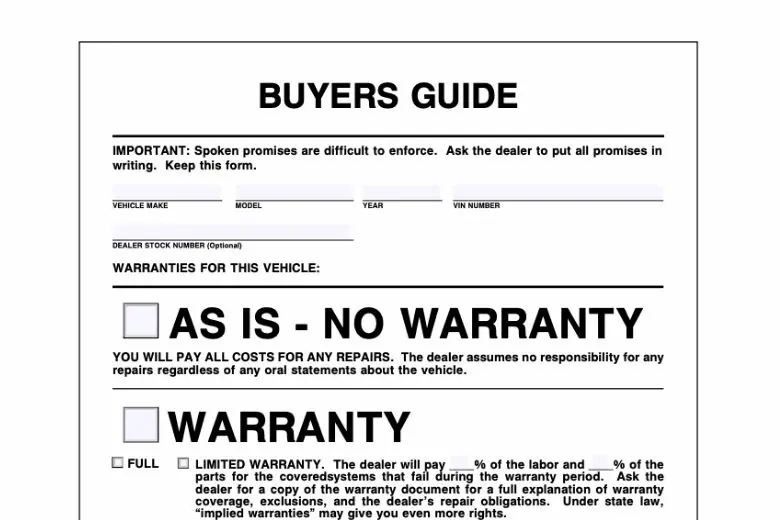
The FTC Buyers Guide tells buyers whether the dealer is providing warranty coverage. Source: Federal Trade Commission.
Covered dealers must display an FTC Buyers Guide on every used vehicle they offer. When the “As Is — No Dealer Warranty” box is checked, the dealer is stating in writing that no dealer warranty comes with the car.
There are actually two versions of the Buyers Guide. State law decides whether a dealer may use the as-is version or must use the “Implied Warranties Only” version instead.
Florida allows as-is sales and has no used-car lemon law, so the disclaimer carries real weight there. New York goes the other way — qualifying dealer-sold used cars must come with a mandatory written warranty under its used-car lemon law.
Two rules matter here. Keep your copy of the Guide, and make sure any negotiated warranty change is written on it — the Guide overrides conflicting language in your sales contract.
The Buyers Guide itself warns that spoken promises are difficult to enforce and tells buyers to get all promises in writing. The government printed that warning on the window sticker for a reason.
Can an as-is car still have a factory warranty or service contract?
Yes, and this is the part most buyers get wrong. “No dealer warranty” is not the same as no coverage from anyone.
An unexpired manufacturer’s warranty may still apply after an as-is dealer sale. The FTC tells buyers to verify remaining coverage by VIN, including what’s covered, when it expires, and what paperwork is required.
This matters on electrified vehicles because battery and high-voltage coverage can use separate terms from the basic warranty. Tesla publishes separate Basic Vehicle and Battery/Drive Unit warranty periods in its current warranty terms. My used-EV buying guide shows exactly what to verify before trusting remaining coverage.
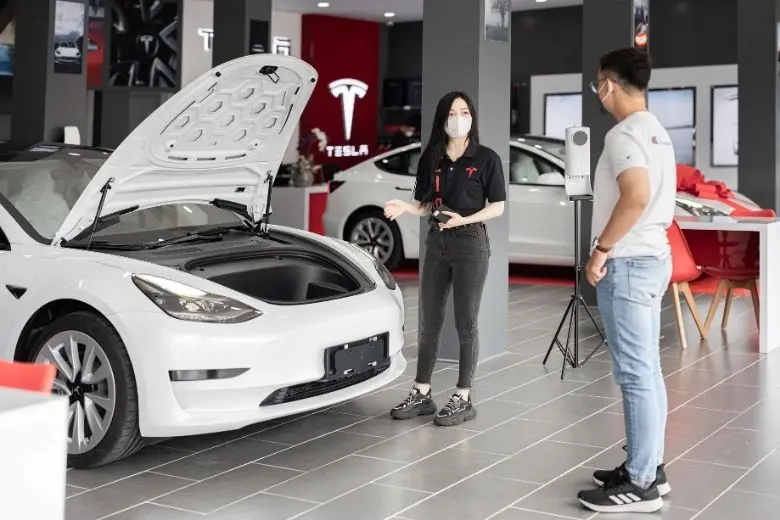
An as-is dealer sale does not automatically erase remaining factory battery or powertrain coverage—verify the exact coverage by VIN.
A service contract is a different animal. It’s a paid repair agreement, not a warranty, and coverage varies by contract, provider, exclusions, and claim rules.
One more nuance: the FTC says a dealer that enters a service contract with you at sale or within 90 days cannot disclaim implied warranties on covered systems. The actual implied-warranty rights still come from state law.
Can you negotiate repairs or price on an as-is car?
Absolutely — as-is limits what happens after signing, not before. Until your name is on the contract, everything is still negotiable.
Here’s how that works in real life. I was helping my son buy a 2022 Cadillac CT5-V that a dealer was selling as-is.
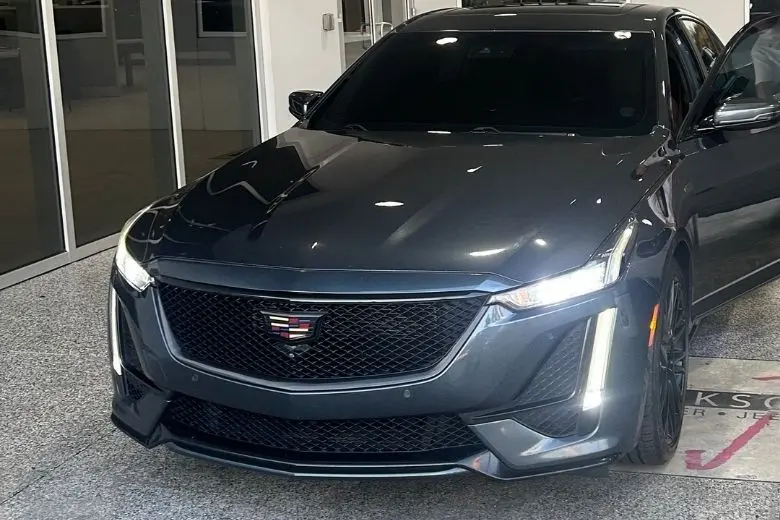
The failing LED daytime-running lights were identified before signing, turning an expensive defect into a written repair.
The LED daytime running lights were failing inside the sealed headlamp assemblies. In our repair, the failed LEDs were not replaceable bulbs, so the written fix called for both OEM headlamp assemblies.
Because we found it before signing, that defect became leverage instead of a surprise. We got both OEM headlamp assemblies written into the buyer’s order before the deal was signed.
The dealer might not have owed us that repair after an as-is sale. Before the sale, they wanted the deal badly enough to put it in writing.
Any of three outcomes makes an as-is negotiation a win. The dealer completes the repair, the exact repair goes in the buyer’s order, or the price drops enough to cover the diagnosed repair plus some risk.
Can you return an as-is car after buying it?
Usually not, and this surprises people. There is no general federal three-day right to cancel a dealer car purchase.
Some states require dealers to offer a cancellation option, and some dealers voluntarily offer a written return policy. The FTC’s advice is to check with your state attorney general for the rules where you live.
Also keep two ideas separate: warranty status and return rights are not the same thing. A car can have zero warranty and a return window, or a full warranty and no returns at all.
If a return promise matters to you, get it in writing before signing. A verbal “bring it back if you hate it” is worth exactly the paper it’s written on.
Can a seller hide problems because the car is sold as-is?
No — as-is shifts ordinary repair risk, it doesn’t license lying. Under the Used Car Rule, misrepresenting a vehicle’s mechanical condition or warranty terms is a deceptive practice for dealers.
Written statements, odometer disclosures, title branding, and state consumer-protection laws can all still matter after an as-is sale. The disclaimer doesn’t erase them.
Here’s the honest mechanic’s caveat, though: proving concealment after the fact is hard, slow, and expensive. Your best protection isn’t a legal remedy later — it’s verification before you pay.
Pull the records and check the car’s service history before the money moves. Paper trails don’t get nervous under questioning.
Are dealer and private-seller as-is sales different?
Yes, meaningfully. The FTC Buyers Guide rules apply to covered dealers, not ordinary private sellers.
Ordinary private sellers do not provide the FTC Buyers Guide because the federal rule targets covered dealers. Warranty rights then depend on state law; Florida’s attorney general says private sellers do not provide implied warranties under Florida law.
That doesn’t make private sales bad. Some of the best used-car deals out there come from buying a car from a private seller with a folder full of receipts.
It just means the safety net is thinner. Verify the title, the seller’s identity, and the story yourself, because nobody’s making them post a disclosure on the window.
When can an as-is car still be a good buy?
When you’ve replaced guessing with verification. My green-light list looks like this:
The real price of an as-is car isn’t the number on the windshield. It’s that number plus every repair you haven’t found yet.
- The seller allows an independent inspection — no conditions, no hovering
- Known defects are diagnosed, not guessed at
- Repair costs are documented in written estimates
- The price actually reflects the condition
- Title, mileage, history, and the seller’s story all match
- Any remaining factory coverage is verified by VIN
- You have a repair reserve that won’t wreck your month
Check every box and you’re not gambling anymore. You’re buying a known car at a price that already accounts for its problems.
Not sure how to check the boxes? My guide on what to check before buying a used car is the full inspection, step by step.
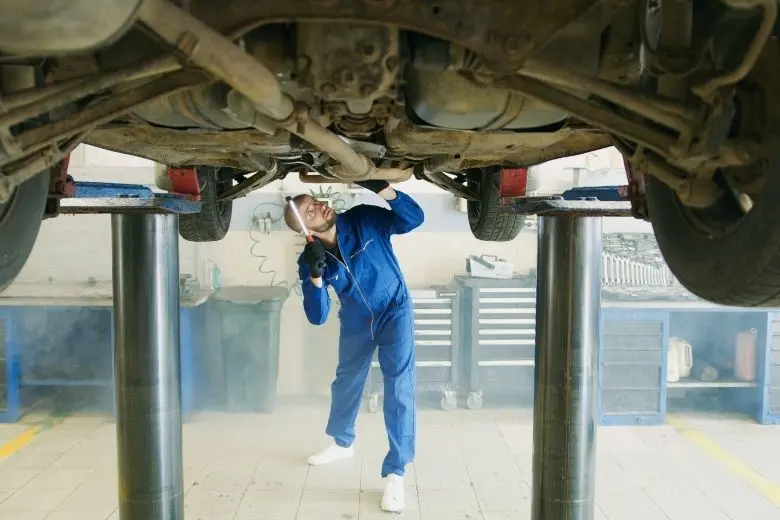
A pre-purchase inspection turns an unknown as-is gamble into a risk the buyer can identify and price.
When should you walk away from an as-is car?
The moment verification gets blocked. A seller who refuses an independent inspection on an as-is car has answered your question for you.
My other walk-away triggers are just as blunt:
- Warning lights were recently cleared, or the story keeps changing
- Major drivetrain, overheating, structural, flood, title, or mileage concerns stay unexplained
- The seller promises repairs but won’t write them down
- The price sits close to a similar car that comes with warranty protection
- You couldn’t absorb a major repair next week without real pain
Most of these overlap with the used-car red flags worth walking away from on any purchase. On an as-is deal they hit harder, because there’s no backstop after signing.
And always drive the car properly before deciding anything. My used-car test-drive checklist exists because half of these problems only show up at road speed.
What’s the right move for your situation?
Here’s the whole decision in one table. Find your row — that’s your next move, not a suggestion.
| Situation | Best move |
|---|---|
| Known wear item with a written estimate | Negotiate the price down |
| Dealer agrees to repair something | Put the exact repair in writing |
| Mechanical condition is unknown | Get a pre-purchase inspection |
| Seller refuses inspection | Walk away |
| Title or mileage story doesn’t match | Walk away |
| Factory warranty may remain | Verify coverage by VIN |
| Price is close to a warrantied alternative | Buy the safer car |
As-Is Risk Triage: what should you do with this deal?
Answer honestly and the tool sorts your deal into one of four moves. It’s buying guidance from a mechanic’s decision process, not legal advice and not a reliability guarantee.
What should you get in writing before signing?
Anything the deal depends on. My rule, after watching too many handshakes evaporate: if it’s important enough to affect the deal, it’s important enough to write down.

Get every promised repair, credit, warranty change, and return condition into the written deal before signing.
Before you sign, your paperwork should nail down:
- The exact repair being promised — part, not just symptom
- OEM or aftermarket part, if it matters to you
- Who pays, and a completion deadline
- Any price credit, stated as a number
- Warranty scope and duration, if any was negotiated
- Any return or cancellation promise, word for word
- Changes marked on the Buyers Guide and the buyer’s order, not just one
- The VIN on every repair or inspection document
That last one sounds paranoid until a dealer claims the estimate was for a different car. VIN on everything, every time.
What should you do if an as-is car breaks after purchase?
Start with paper, not panic. Gather the Buyers Guide, contract, the ad, your inspection report, texts with the seller, the repair diagnosis, and any warranty documents.
Compare the failure against anything written — factory coverage, a service contract, or a promise in the buyer’s order. If the failure lands inside written coverage, contact the seller in writing and keep copies.
If you believe you were misled, your state attorney general or consumer-protection office is the right first stop. For a failure big enough to justify it, get legal advice on your state’s specific rights.
One honest note: this article is general buying guidance, not state-specific legal advice. The rules genuinely differ depending on where you bought the car.
What do buyers ask most about as-is car sales?
Is it okay to buy a car as is?
Yes, if you verify the car instead of trusting the label. An inspected as-is car at a condition-adjusted price is a reasonable purchase; an uninspected one is a gamble.
Why do dealers sell cars as is?
Often it’s economics, not proof the car is bad. A dealer may decide an older or higher-mileage car isn’t worth additional reconditioning or warranty exposure, then price that risk into the deal.
Can you negotiate an as-is car?
Yes — as-is limits post-sale obligations, not pre-sale negotiation. Diagnosed defects with written estimates are your leverage for a completed repair, a written repair promise, or a lower price.
Can you return an as-is vehicle?
Generally no, because there’s no general federal three-day right to cancel a car purchase. A written dealer return policy or your state’s law can change that answer, so check both before signing.
Does as-is mean the factory warranty is gone?
No — not necessarily. As-is addresses the dealer’s warranty obligations, while an unexpired manufacturer’s warranty may still apply. Verify remaining coverage by VIN before buying.
What happens if an as-is car breaks the next day?
For an ordinary failure, the repair is typically yours even one day later. Check written coverage and promises first, and contact your state consumer-protection office if you believe the car was misrepresented.
What’s the bottom line on buying a car as-is?
Buy the condition you verified, not the seller’s story. As-is isn’t a warning label or a green light — it’s a question about who eats the next repair bill, and you get to answer it before signing.
Inspect everything, ask the questions that expose a shaky story, and put every promise in writing. Once an as-is deal is signed, surprises get expensive fast.