
Quick answerThe best mileage for a used car, for me, is roughly 10,000 to 40,000 miles on a car one to three years old. That is my buying strategy, not a guarantee.
The right number shifts with the exact model, the service history, the warranty left on it, the price, and how long you plan to keep the car. No odometer reading by itself tells you what condition a car is in.
Last updated: August 5, 2026
- What is the best mileage for a used car?
- Why do mileage guides give different sweet spots?
- Why have I bought only one brand-new car?
- What is normal mileage for a used car’s age?
- What do you gain at lower mileage, and what does it cost?
- What changes as mileage goes up?
- Why can a low-mileage car still be a bad buy?
- How much should owner count change the decision?
- Why does the exact make and model change the answer?
- What is the best mileage for a used EV or Tesla?
- Frequently asked questions
Ask this question online and you will find plenty of confident answers. My range is 10,000 to 40,000 miles, and it is a personal rule rather than a law.
A mileage range is useless unless it matches your budget and ownership plan. I have spent more than 25 years as a mechanic, owned somewhere between 20 and 30 cars, and bought exactly one of them new.
Here is what an odometer reading actually tells you, what it hides, and how I use it when I shop.
What Is the Best Mileage for a Used Car?
10,000 to 40,000 miles on a car one to three years old, one owner where I can get it. That is the filter I use, not a standard I think every buyer should adopt.
It works for me because the first owner has already absorbed some early depreciation while factory coverage may still be running. It narrows a listings page down to a shortlist, and it says nothing about any specific car on it.

One- to three-year-old cars: the range I shop, and the range where warranty runway is usually still on the table.
A car showing 22,000 miles can arrive with a missing service history and a branded title. A car showing 80,000 documented highway miles from one careful owner can be the better purchase.
Mileage is a filter, not proof.
Good mileage for a used car, best mileage, ideal mileage: the phrasing changes and the honest answer does not. Treat the number as your first question rather than your last one.
What you are actually buying is the useful life remaining, the warranty still attached, and the risk this specific car carries at this price. The odometer is one input into that, and not the biggest one.
Why Do Mileage Guides Give Different Sweet Spots?
Mileage guides often give different ranges, and each one can sound certain. Compare a few before you settle on a number.
My read on why: they are answering different questions without saying so. A range built around keeping factory warranty cannot match a range built around the lowest price per remaining mile.
The problem is not that any single range is wrong. It is that a range rarely explains which assumption shaped it, and that missing context matters more than the number.
A buyer keeping the car two years needs a different number than someone planning to keep it a decade. Those ranges may reflect different buying priorities rather than competing facts.
Why Have I Bought Only One Brand-New Car?
One new car out of roughly 20 to 30. The smell goes away fast, and the depreciation does not.
The first owner absorbs some of the early value loss and then hands over a car with much of its service life intact. That trade is the entire argument for buying used, and it is why my range starts at about one year old.
It is also why an odometer on its own does not impress me. Low miles tell you how far a car has traveled and nothing about how it was treated.
What Is Normal Mileage for a Used Car’s Age?
A single annual-mileage rule sounds simple, but the federal data changes depending on what you divide by. That denominator matters when you compare an odometer with a car’s age.
The Federal Highway Administration’s Highway Statistics 2024 table VM-1 reports 10,787 average miles traveled per registered light-duty vehicle. Light duty covers passenger cars, light trucks, vans, and SUVs, which is exactly what you are shopping for.
The same FHWA row reports 11,071 miles for all motor vehicles. That broader total takes in motorcycles, buses, and heavy trucks, so the light-duty figure is the closer match for a car shopper.
FHWA also publishes a per-driver figure, and it is much higher. It is also much older.
Check which denominator a benchmark usesThe FHWA table reporting a 13,476-mile average per driver appears in Our Nation’s Highways: 2000, and FHWA credits its source as the 1995 Nationwide Personal Transportation Survey.
That is a per-driver figure from a survey conducted three decades ago. The current per-vehicle light-duty number is the better match for comparing an odometer against a car’s age.
Three denominators, three different answers. Which one a benchmark used is worth checking, because you are buying a vehicle rather than a driver.
The light-duty average fell from 11,106 miles in 2023 to 10,787 in 2024. Multiply the car’s age by roughly 10,800 and you have a baseline.
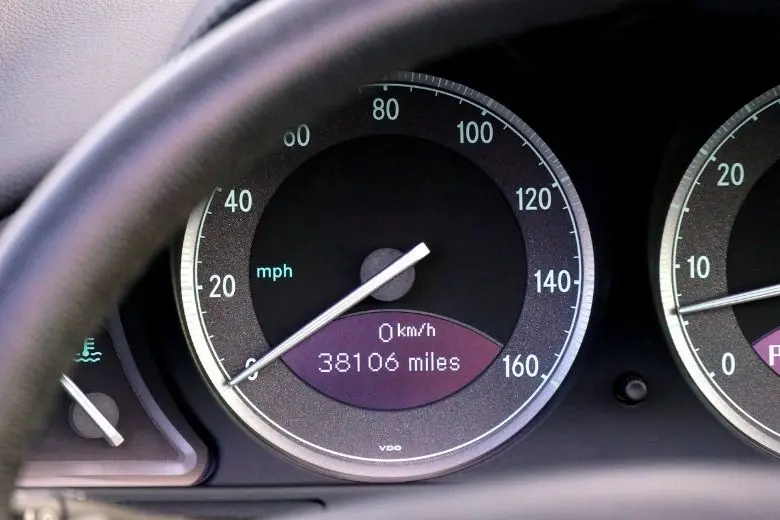
An odometer tells you distance traveled. It does not tell you how those miles were driven.
A baseline is context and nothing more. A car above it can be in better mechanical shape than a car below it, which is why the calculator below reports the gap without grading it.
Enter the odometer reading and the car’s age. The tool compares it against the FHWA 2024 light-duty benchmark.
What Do You Gain at Lower Mileage, and What Does It Cost?
Lower miles buy you time rather than certainty. The most concrete thing they buy is warranty runway.
Coverage terms vary by brand, by model year, and by whether anything the first owner did voided part of it. Look up the exact car instead of trusting a rule of thumb.
One federal baseline applies across brands. The EPA requires manufacturers to warrant specified major emission control components for 8 years or 80,000 miles on qualifying vehicles, meaning the catalytic converter, the emissions control computer, and the onboard diagnostic computer.
The coverage applies to used vehicles too, but conditions apply and a manufacturer can deny a claim caused by improper use or maintenance rather than a defect. That makes it worth checking before you pay for a qualifying repair.
| Lower mileage | Higher mileage |
|---|---|
| More factory coverage left | Little or none left |
| Newer safety and driver-assist hardware | Older hardware, sometimes dated |
| Fewer wear items due soon | Tires, brakes, fluids and belts closer to due |
| Thinner maintenance record to judge | Longer record, more evidence to read |
| Higher price, more depreciation still ahead | Lower price, slower depreciation from here |
What Changes as Mileage Goes Up?
Price drops, warranty runway shrinks, and the paper trail gets longer. That last one works in your favor.
A car at 70,000 miles has accumulated a longer evidence trail. There may be receipts to read, wear patterns to inspect, and a service history that either exists or conspicuously does not.
More wear items come due as well: tires, brakes, fluids, belts, suspension bushings. None of that is a defect, it is scheduled spending you should price into your offer.
Where the risk genuinely starts climbing is a separate question, and I answered it in how many miles is too many on a used car. This page is about what you are buying at a given mileage, not about where the ceiling sits.
Why Can a Low-Mileage Car Still Be a Bad Buy?
Cars are machines that prefer to be used. One that sat for years comes with its own list of problems.
Rubber hardens, seals shrink, rotors surface-rust, and fuel goes stale. Tire dry rot turns up on tread that still looks close to new.
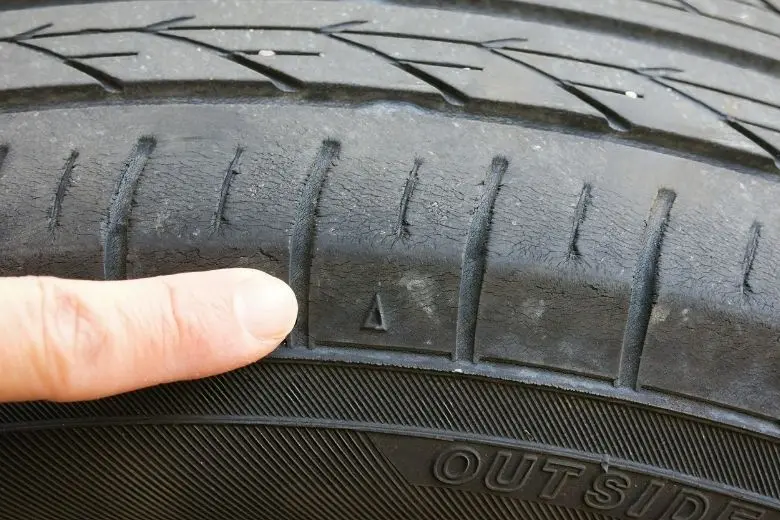
Fine sidewall cracking can reveal age-related tire deterioration even on a low-mileage car.
Short-trip driving is the other trap. AAA notes that repeated short trips can allow combustion contaminants to build in engine oil, which is why how a car was driven matters as much as how far.
Then there is what a low number cannot hide: collision damage, flood history, skipped maintenance, and a price inflated by the low reading itself. Work through the used car red flags before the number talks you into anything.
How Much Should Owner Count Change the Decision?
Every owner brings a different set of habits. Warm-up routines, oil intervals, how long they drove with a warning light on, and what they were willing to spend when something broke.
One owner means one set of habits to evaluate. Three owners in five years means three sets, plus the question of why each of them left.
This is risk assessment, not arithmetic60,000 miles across three owners is not automatically worse than 90,000 across one. It is harder to evaluate, which is a different problem, and documentation is what solves it.
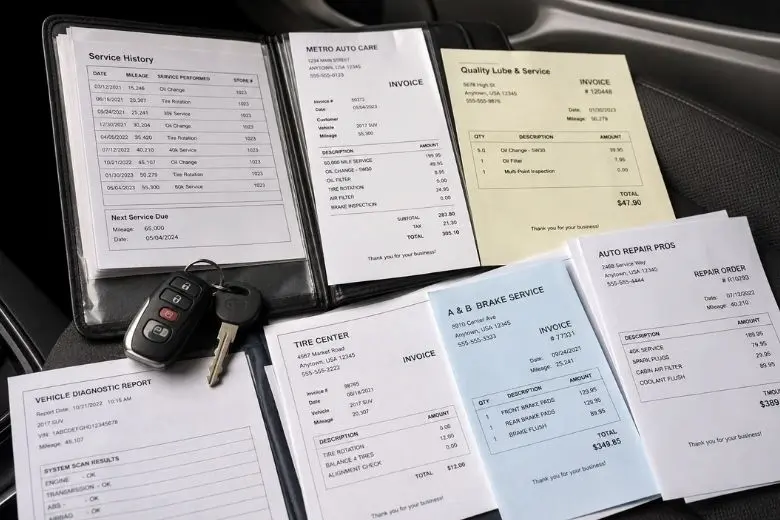
A full stack of receipts from three owners beats a clean title and no paperwork from one.
Use owner count to decide how hard to dig rather than to score the car. Learning to check a car’s service history turns the count from a worry into something you can actually verify.
Why Does the Exact Make and Model Change the Answer?
Forty thousand miles on one model is a different purchase than 40,000 on another. Known failure points, parts prices, and service schedules do not average out across brands.
I apply different mileage limits to different cars. I will accept more miles on a proven model with sensible parts prices than on something carrying expensive known problems or a warranty about to expire.
That is a personal buying rule, not a reliability finding. Before you set your own limit, look up what that specific model and engine need at that specific mileage.
My daily driver is a 2020 Honda Insight with well over 150,000 miles on it, still running its original brake pads. Regenerative braking does most of the slowing on a hybrid, so the pads barely wear, and no general mileage rule would ever catch that.
What Is the Best Mileage for a Used EV or Tesla?
On an EV, mileage reads more like a warranty clock than a combustion-engine wear measurement. There is no combustion engine and no timing belt, but a drive unit still contains reduction gearing, bearings, seals and lubricant.
Tesla’s service manual includes a gearbox fluid drain and refill procedure for the Model 3 front drive unit that procedure covers, including an oil pump and an oil filter. EV mileage still counts mechanically, even without a combustion engine.
Tesla’s US warranty page lists a Basic Vehicle Limited Warranty of 4 years or 50,000 miles. Battery and drive unit coverage runs 8 years, capped at 100,000, 120,000 or 150,000 miles depending on the model and trim.
The battery warranties listed by Tesla include a minimum 70% capacity-retention term. Tesla also notes that the warranty supplied with the individual vehicle is authoritative, so check the car rather than the marketing page.
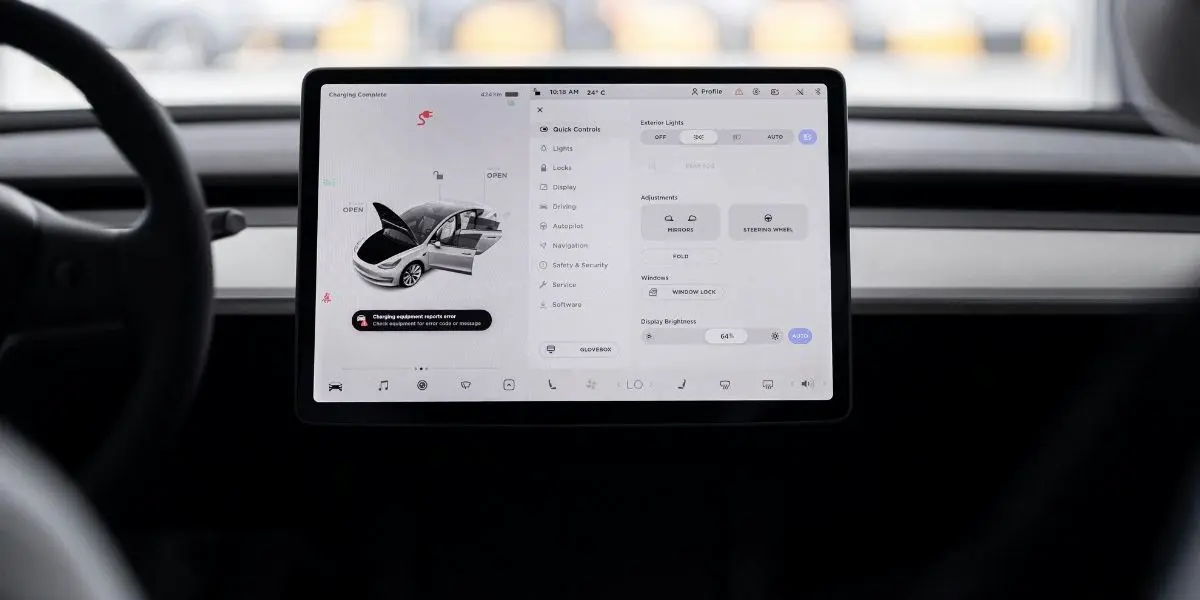
For a used EV, battery-health evidence and remaining warranty matter more than mileage alone.
For a used EV, then, the useful questions are how many warranty years and miles remain and what the battery health report shows. If you are shopping with a hard budget, our 15-listing used EV sample under $20,000 shows how dramatically mileage changed across five model families at the same price ceiling. Buying a used electric car walks through the full process, and EV depreciation explains why the prices look the way they do.
Once you have a range, stop looking at the odometer and start inspecting the car. What to check before buying a used car is the next step, and the mileage becomes a negotiating input only after you know the condition.
The rest of the SpotForCars buying advice guides pick up from there.
Frequently Asked Questions
What is the best mileage range to buy a used car?
I shop between roughly 10,000 and 40,000 miles on a car one to three years old, which is a personal rule rather than a universal one. That range fits my preference for a newer used car with useful warranty runway. Your own range depends on budget, how long you plan to keep the car, and the model you are looking at.
What is considered low mileage for a used car?
Relative to the FHWA 2024 benchmark of 10,787 miles per registered light-duty vehicle, anything meaningfully under age times 10,800 reads as low. A three-year-old car under about 32,000 miles fits that description. Low compared with the benchmark is a statement about distance, not about condition.
Is it better to buy a used car with low or high mileage?
Lower miles usually mean more warranty and fewer wear items due, at a higher price. Higher miles usually mean a lower price and a longer service record you can actually inspect. Which one wins depends on the individual car’s history and on how long you intend to keep it.
Should I buy a used car with 40,000 miles?
Against the FHWA light-duty benchmark, 40,000 miles is close to four years of average use and above three years of it. Whether it is a good purchase depends on the service records, previous owners, accident history, and what that model needs next. The odometer answers one question out of five.
Is 50,000 miles good for a used car?
Fifty thousand miles sits between four and five years of use under the FHWA light-duty benchmark. It says nothing on its own about wear, because how the miles were driven matters more than how many there were. Ask for the maintenance history before you treat the number as reassuring.
Is 50,000 miles in four years bad?
That works out to 12,500 miles a year, about 16% above the 2024 light-duty benchmark of 10,787. The number sits above the benchmark, and that alone does not prove good or bad condition. Check the service history, use pattern, ownership, and exact model before deciding.