Electric cars in cold weather — they just lose range and charge slower until they warm back up. A realistic winter hit is roughly 20% to 40%, depending on temperature, speed, and how hard you run the heater.
Recurrent’s 30,000-car study found EVs kept about 78% of normal range at 32°F and 70% at 20°F. The harsh case — 20°F with the heater blasting — pushes the loss toward 41%, per AAA and federal testing.
The cold doesn’t permanently hurt the big battery; full range comes back in spring. And yes, an EV still has a little 12-volt battery that can leave the car asleep — same part I’ve replaced for 25 years.
What’s on this page
- Do electric cars start in cold weather?
- Why does a gas battery fail differently than an EV battery?
- How much range do electric cars lose in cold weather?
- Why does EV charging slow down in the cold?
- Can your EV’s 12-volt battery leave you stranded?
- When does cold weather actually matter?
- How do you keep more range in winter?
- Should you look for a heat pump?
- Is winter a dealbreaker for electric cars?
- FAQ
Years ago in Poland, on the coldest winter nights, we used to disconnect the car battery and carry it into the house. Carburetor cars, freezing temperatures, and a 12-volt battery too weak to crank the engine in the morning.
That little battery is the whole reason gas cars struggle to start in the cold. It’s also the part of this story everybody gets backwards once you bring electric cars into it.
So let’s clear the snow off this properly. I’ve spent 25 years under cars in real winters — Poland, Germany, New York, New Jersey — and the cold-weather EV question splits cleanly into two problems that nobody online keeps straight.
Do electric cars start in cold weather?
Yes. An electric car has no engine to crank, so it never gives you that click-click-click dead-battery morning a gas car does.
This is the misconception buried in nearly every “do EVs work in winter” search.
People picture the gas-car failure — engine won’t turn over — and assume EVs do the same. They don’t.
Cold doesn’t stop an EV from starting. It shows up as lost range and slower charging instead, which is a completely different problem with completely different fixes.
Gas car cold problem: the small battery can’t crank the engine. EV cold problem: the big battery loses range and charges slower.
Two different batteries, two different failures. Keep them separate and winter EV ownership stops being scary.
Why does a gas battery fail differently than an EV battery?
A gas car asks its 12-volt battery to do one violent thing: spin a cold engine fast enough to fire. When that battery is frozen and weak, it can’t deliver the punch, and you get nothing.
An electric car never asks for that punch. There’s no engine to spin, so the “won’t start” failure mode mostly disappears.
What the cold does to the big traction battery is quieter. Lithium-ion chemistry slows down, so the pack holds less usable energy and releases it more slowly.
The simple version: cold slows the reactions inside the cells and raises resistance. The battery can still power the car — some of its energy just gets harder to use until it warms up.
That slowdown is temporary. Warm the pack back up and the range returns — the chemistry was never damaged, just sluggish.
How much range do electric cars lose in cold weather?
The honest answer is a range, not a number: roughly 20% to 40%, driven mostly by how cold it is and how hard the heater works. Anyone giving you one tidy figure is hiding the conditions.
Recurrent’s 2025/26 winter study pulled real driving data from more than 30,000 vehicles. On average, EVs held 78% of normal range at 32°F and 70% at 20°F.
The scary headlines come from the harsh case. AAA’s dynamometer testing found that at 20°F with the heater running, range dropped by 41% on average.
The federal fuel-economy program reports the same roughly 41% figure.
Here’s the part that flips it: turn the cabin heater off and the loss collapses to about 12%. The Department of Energy says about two-thirds of the extra winter energy goes to heating the cabin, not to fighting the cold itself.
| Winter scenario | Range you keep | Source |
|---|---|---|
| Typical day, 32°F (0°C) | ~78% (loses ~22%) | Recurrent |
| Colder day, 20°F (−7°C) | ~70% (loses ~30%) | Recurrent |
| Harsh: 20°F, heater on full | ~59% (loses ~41%) | AAA / DOE |
| 20°F, cabin heater off | ~88% (loses ~12%) | DOE |
| Gas car, city driving, 20°F | loses ~15–20% mpg | DOE |
The spread between models is real, but I wouldn’t reduce it to one magic number. In the current Recurrent study, the best winter performer kept 88% of its range at 32°F, while the weakest kept just 69%.
That gap comes down to thermal management and whether the car has an efficient heat pump — more on that below.

The bottom row matters too. Gas cars lose range in the cold as well — you just never notice, because refueling takes three minutes instead of forty.
The flip side of all this is summer — I broke that down in EV range in hot weather.
For real-world range outside of winter, see our breakdown of how far electric cars actually go on a charge.
Winter range estimator
Enter your EV’s rated range and see realistic winter numbers. Based on Recurrent and AAA testing.
Estimates only — real numbers depend on speed, wind, terrain, and cabin warmth. Highway speeds make it worse; seat heaters instead of cabin heat make it better.
Why does EV charging slow down in the cold?
A cold battery can’t safely accept fast power. The car deliberately throttles the charge rate to protect the cells until the pack warms up.
This is the trade-off that surprises new owners. Your daily home charging barely notices, but a DC fast-charging stop in deep cold can take noticeably longer than the number on the screen suggests.
The fix is built into the car: preconditioning. When you navigate to a fast charger, most EVs warm the battery on the way so it’s ready when you plug in.
Tesla, for example, limits power and charge speed near freezing unless the pack is preconditioned first.
If you want the full picture on charging speeds before you read about winter, start with how DC fast charging works. Cold weather just adds a warm-up step to everything you already knew.
Can your EV’s 12-volt battery leave you stranded?
This is the part nobody on page one tells you, and it’s the one that comes straight from my toolbox. Your electric car still has a small 12-volt battery — the exact same kind of part I’ve been replacing in gas cars for 25 years.
It doesn’t crank an engine. It runs the computers, the door locks, the screens, and the contactors that wake the big battery up.
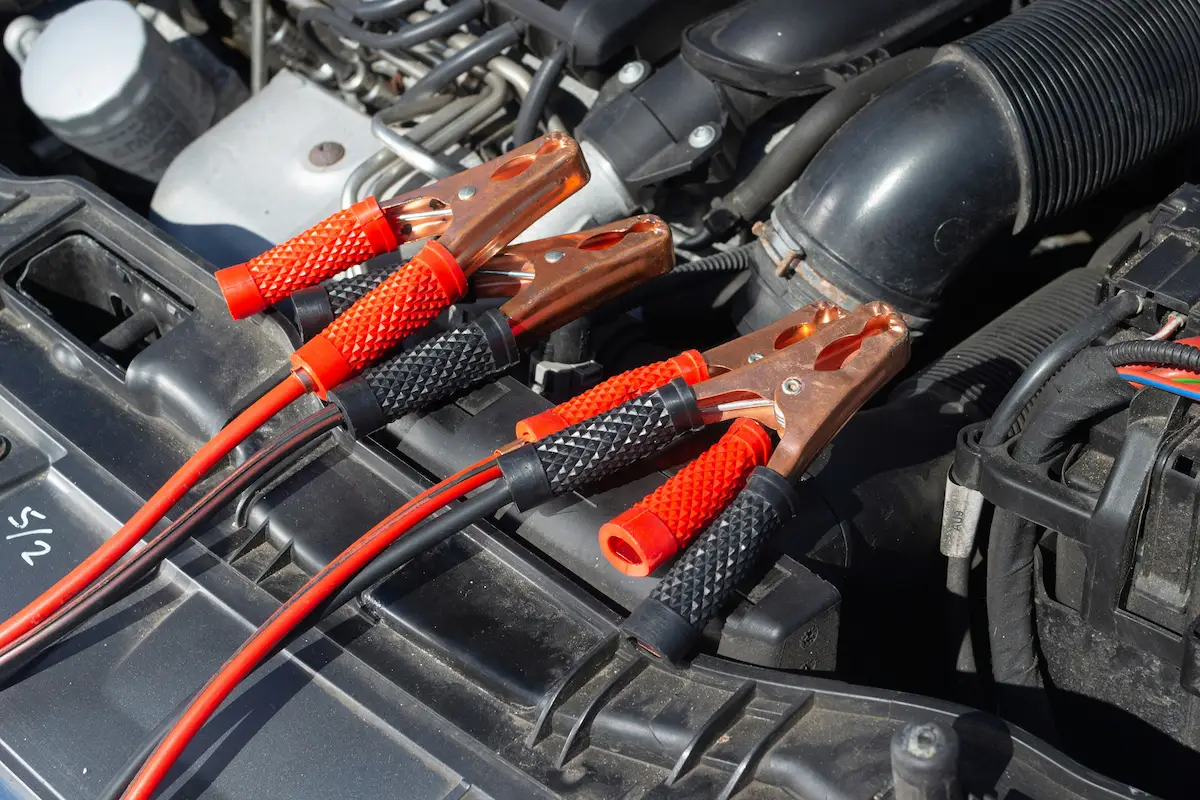
And here’s the twist: in deep cold, that little 12-volt battery can die even when the big pack is full. When it does, the car can act completely dead — doors won’t unlock, screen won’t wake, charging won’t start.
If a Tesla’s 12-volt battery dies, you can’t unlock the car normally, and Tesla publishes a jump-start procedure for the low-voltage battery.
So EVs don’t crank-fail like a gas car — but the little battery can still ruin your morning.
This is not a reason to fear an EV. It’s a reason to treat it like any car: a weak 12-volt battery is a wear item, and replacing it is routine.
Heads up: a couple of links below are affiliate links. If you buy through them, I may earn a small commission — at no extra cost to you.
If you live somewhere genuinely cold, I’d keep the same thing in the frunk that I keep in every car I own: a compact 12-volt lithium jump pack like the NOCO Boost GB40. It revives a dead 12-volt in any car, gas or electric, and doubles as a phone power bank.
When does cold weather actually matter?
This is where every other article goes soft, because everybody writing them is selling something. I’m not, so here’s the honest line.
For a daily commute, cold weather barely matters. Lose 30% of a 300-mile car and you’ve still got over 200 miles for a trip most people measure in dozens.
Where it gets real is the winter road trip on public fast chargers. Now you’re stacking the worst factors at once: highway speed, a cold pack charging slowly, and stations spaced for summer range.
Daily driving in winter: plug in at home, ignore the range drop, get on with your life. Long winter trip: plan stops with a real cushion and precondition before every charge.
Consumer Reports puts a number on the safe approach. For cold-climate buyers, they recommend a car rated for about double your daily driving need.
That cushion absorbs the worst winter day without drama.
How do you keep more range in winter?
None of this is exotic. It’s the same logic as warming a car up before you beat on it cold — which any mechanic will tell you matters.
Precondition while plugged in. Warm the cabin and battery on grid power before you unplug, so you’re not spending range to do it — the Department of Energy calls it the single best winter habit.
Heat the person, not the cabin. Seat and steering-wheel heaters sip energy next to blasting the air, and since cabin heat is the biggest drain, this one move recovers a lot.
Park covered when you can. A garage keeps the battery closer to the 40°F–115°F zone lithium-ion likes, and finishing a charge right before you leave keeps the pack warm — easier with good home charging.
One more, and it’s the one I’d argue hardest for. If you drive in real snow and ice, the most important winter upgrade isn’t a setting — it’s tires.
All-season tires are a compromise that gets unsafe below about 45°F. A dedicated set of winter tires from Tire Rack does more for cold-weather safety than any range trick on this page.
Stopping distance on ice is not where you want to cut corners.
Regenerative braking also weakens until the pack warms, so don’t be surprised if one-pedal feel is soft on the first cold mile. Here’s why regen behaves that way and why it bounces back.
Should you look for a heat pump?
If you’re buying an EV for a cold climate, this is the one spec I’d chase above almost any other. A heat pump heats the cabin far more efficiently than a plain resistance heater.
The data is blunt enough without overcomplicating it. Recurrent says a heat pump adds about 10% more winter range at 32°F.
On a cold road trip, that 10% swing from one component can be the difference between reaching the next charger comfortably and sweating it.
Ask whether the exact model year and trim has a heat pump — automakers add and drop them between years. It’s the cheapest insurance against winter range loss you’ll find on a spec sheet.
This matters most on used cars, where heat-pump availability shifted year to year. If you’re shopping winter EVs, it folds right into the bigger question of whether an electric car is right for you at all.
Is winter a dealbreaker for electric cars?
No — and the proof is a country, not a tip. Norway is the world’s EV leader, with about nine of every ten new cars sold being electric, in a climate that makes most of America look mild.
Every winter, Norway runs the El Prix test — the largest real-world EV range test on earth. In 2026 it pushed 24 cars to −32°C, and even there the cars stayed reliable and comfortable.
They lost range — about 38% on average against the optimistic lab rating. But they didn’t strand people, and a whole nation keeps buying them anyway.
Winter is a planning problem for EVs, not a reliability problem. Precondition, run a margin on trips, buy a heat pump, and put real winter tires on it.
Do that and the cold goes from scary headline to minor footnote. The chemistry recovers every spring — and you can dig into what really happens to an EV battery long term if you’re worried about lasting damage.
For everything else about living with an electric car, the rest of our EV Guide walks through charging, range, and ownership in the same plain language.
Frequently asked questions
Do electric cars start in cold weather?
Yes. An EV has no engine to crank, so it doesn’t suffer the dead-battery, no-start problem a gas car does. Cold shows up as reduced range and slower charging, not a failure to start.
How much range does an electric car lose in cold weather?
Typically 20% to 40%. Recurrent found EVs keep about 78% of range at 32°F and 70% at 20°F, while AAA measured a 41% loss in the harsh case of 20°F with the heater running full blast.
How cold is too cold for an electric car?
There’s no hard cutoff for daily use — EVs ran fine in Norway’s testing at −32°C, though range drops and charging slows in extreme cold. Lithium-ion batteries are happiest roughly between 40°F and 115°F.
Do EVs charge slower in winter?
Yes. A cold battery limits how fast it can safely accept power, so fast charging takes longer until the pack warms. Preconditioning the battery before you plug in largely fixes this.
Does cold weather permanently damage an EV battery?
No. Cold temporarily slows the battery chemistry, but it causes no permanent damage. Full range returns once the weather warms back up.
Should I plug in my EV every night in winter?
It helps. Leaving it plugged in lets the car keep the battery in its ideal temperature range and lets you precondition on grid power. You don’t have to charge to full — just stay plugged in.
Can I leave my electric car parked outside in freezing temperatures?
Yes, it’s fine for normal stretches, and covered parking is better when you have it. Plugging in during very cold spells helps the car protect the battery, though range may read lower until it warms up.
Sources: Recurrent winter range study · AAA EV range testing · DOE / FuelEconomy.gov cold weather · DOE winterizing guide · Consumer Reports · FIA / NAF El Prix 2026 · Tesla Model 3 owner’s manual