
Quick Answer
How long does it take to charge an electric car?
- Level 1 (120V outlet): 3–5 miles of range per hour. A full charge from empty takes 40–50+ hours. Fine for PHEVs, rough for full EVs.
- Level 2 (240V home charger): 15–30 miles per hour. A full charge takes 4–10 hours. You plug in at night, wake up full. This is what most EV owners actually use.
- DC Fast Charging (Level 3): 100–200+ miles in 20–30 minutes. 10% to 80% in 20–60 minutes depending on the car. Highway stops, not daily driving.
- The honest answer: Many EV owners stop thinking about charging time within a week. You plug in at home like a phone. The question isn’t how long it takes — it’s whether it fits your life.
In This Guide
- Why “How Long Does It Take” Is the Wrong Question
- How Long Does It Take to Charge an Electric Car at Home?
- How Long Does It Take to Charge at a Public Charging Station?
- How Long Does Charging Take for Popular EVs?
- What Actually Affects How Long Charging Takes?
- Should You Charge to 100% Every Night?
- Which Charging Setup Is Right for Your Life?
- What If You Live in an Apartment?
- How Long Does It Take to Charge a Hybrid Car?
- What’s My EV’s Charging Time? [Calculator]
- Frequently Asked Questions
The number one question people ask before buying an EV isn’t about range. It’s about charging.
Specifically: is this going to be a pain in my ass every single day? Let’s actually answer it.
Why “How Long Does It Take to Charge an Electric Car” Is the Wrong Question
The question assumes you’re thinking about charging like pumping gas — pull up, wait, leave. That’s not how EV ownership works.
Here’s the mental shift that changes everything: you don’t charge an EV, you top it off.
Think about your phone. You don’t wait until it’s at 0% and then stand next to the outlet for an hour while it charges.
You plug it in at night, leave it there, and wake up at 100%. You haven’t thought about charging time in years.
That’s exactly how EV ownership works when you have a home charger. You park, plug in, go to bed, wake up with a full battery.
The Real Question
Not “how long does charging take?” but “does charging fit my life?” The answer depends entirely on whether you can plug in at home. Everything else flows from that.
Before the time estimates make sense, it helps to understand how EV charging actually works — including why Level 1, Level 2, and DC fast charging behave so differently.
The people who find EV charging annoying are almost always people who can’t charge at home — apartment dwellers using public chargers for everything, or people relying on DC fast charging for daily driving.
We’ll cover that honestly. But for the majority of homeowners with a driveway or garage, charging time is something you stop thinking about after week one.
How Long Does It Take to Charge an Electric Car at Home?
There are two home charging options, and the difference between them is massive.
Level 1 Charging (120V Standard Outlet)
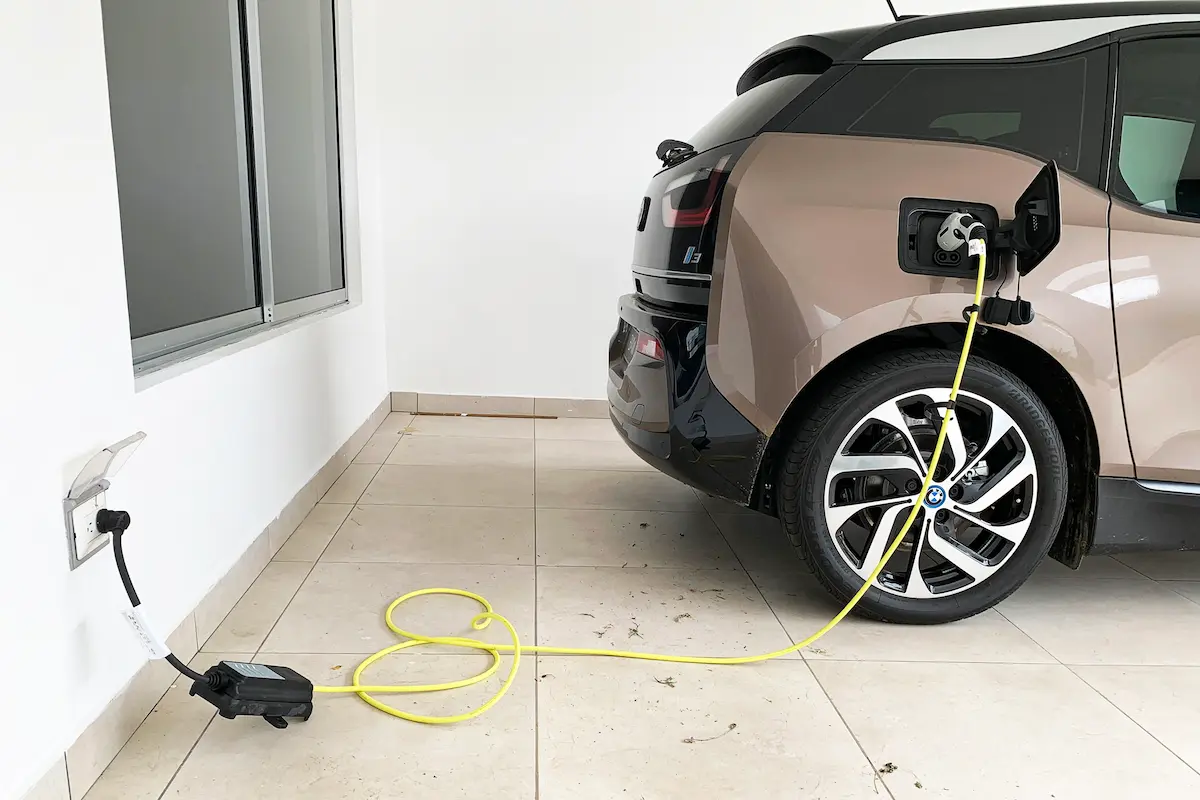
Level 1 uses the same standard outlet as your phone charger, your toaster, your lamp. Every EV comes with a Level 1 cable you can plug in anywhere.
According to the U.S. Department of Transportation, Level 1 delivers 3–5 miles of range per hour of charging.
A full EV battery (let’s say 75 kWh) takes 40–50 hours to fully charge from empty on Level 1. That’s not a typo.
Let’s be honest about this: Level 1 is fine for one specific situation. If you drive 20–30 miles a day and plug in every night, you’ll recover roughly 40–50 miles overnight.
The moment your daily driving exceeds what Level 1 can recover overnight, you fall behind. Road trips become a problem.
Any day where you drive more than usual leaves you short. Level 1 on a full BEV is a slow leak you’re constantly chasing.
PHEVs (plug-in hybrids like the Toyota RAV4 Prime or Kia Sorento PHEV) are a different story. Their battery packs are much smaller — 14–20 kWh instead of 60–100 kWh.
Level 1 charges a PHEV battery fully in 5–6 hours. For PHEV owners, Level 1 is genuinely sufficient.
Level 2 Charging (240V Home Charger)

Level 2 uses a 240V circuit — same voltage as your dryer or electric range. It delivers 15–30 miles of range per hour, and charges most EV batteries fully in 4–10 hours.
Not sure if you actually need a Level 2 charger at home, or what it costs to install one? Our full guide covers what Level 2 charging is and whether you actually need it.
This is the setup that converts skeptics. Plug in when you get home at 6 PM, wake up at 7 AM, full battery.
If you want the right wall unit for that setup, see my best home EV chargers guide before buying one.
Every single day. You genuinely stop thinking about it.
The hardware costs $180–$700 for a quality Level 2 charger. Installation by a licensed electrician runs $200–$1,200 depending on your panel’s location and whether you need a panel upgrade.
Here’s the part most articles skip: the IRS Section 30C Alternative Fuel Vehicle Refueling Property Credit gives you 30% back on the charger and installation, up to $1,000 total — but only if you install by June 30, 2026 and your address is in a qualifying census tract (most rural and many suburban addresses qualify).
Check your eligibility using the DOE’s Alternative Fuels Data Center before assuming you qualify. The census tract requirement catches a lot of people off guard.
This section contains affiliate links. If you buy through them, SpotForCars may earn a commission at no extra cost to you.
Our Home Charger Pick
The Emporia Level 2 EV Charger supports up to 40A/9.6kW through the NEMA 14-50 plug shown on Amazon, or up to 48A/11.5kW when professionally hardwired. It has a 25-foot cable, built-in WiFi smart app, UL certification, and Energy Star certification. It charges as fast as most EVs can accept without making you pay extra for a bigger name.
How Long Does It Take to Charge an Electric Car at a Public Charging Station?

Public charging breaks into two completely different experiences depending on what kind of charger you’re using.
Before you worry about stop length, make sure the stop is worth using with this guide to find EV charging stations that fit your route and vehicle.
Level 2 Public Chargers
These are the chargers you find in mall parking lots, hotel garages, workplaces, and grocery stores. Same 240V technology as your home setup — about 25–30 miles of range per hour.
They’re not for charging from empty. They’re for topping off while you’re already parked doing something else.
Two hours at Costco, you’ve added 50 miles. That’s the right use case.
DC Fast Charging (Level 3)
DC fast charging is what you use on road trips and on days when your home charging didn’t cover you. According to the U.S. Department of Transportation, DC fast chargers deliver 100–200+ miles of range in 20–30 minutes.
Most cars can go from 10% to 80% in 20–60 minutes depending on the vehicle. The variation is almost always your car’s onboard charge rate — not the charger itself.
For the full breakdown — charge curves, network comparisons, and exactly why speed varies so much between cars — the DC fast charging guide covers it in depth.
You find them along highway corridors, at Walmart, Target, and rest stops. Tesla’s Supercharger network is the largest in the US — 36,877 stalls as of April 2026, accounting for more than half of all domestic DC fast-charging ports.
Non-Tesla networks (Electrify America, EVgo, ChargePoint) have improved significantly but aren’t as seamless. That’s the honest assessment in 2026.
⚡ The Cost Difference Is Real
DC fast charging at a public station typically runs $0.40–$0.60 per kWh. Charging at home on Level 2 costs roughly $0.17 per kWh — the current U.S. residential average per EIA data. If you’re doing all your charging at DC fast stations instead of home, you’re paying 2–3x more per mile — and most of the cost advantage EVs have over gas disappears. See our full EV cost breakdown for the real numbers.
How Long Does Charging Take for Popular EVs?
Generic numbers only get you so far. Here’s how charging actually plays out for some of the most common EVs on the road right now.
The DC fast column is 10–80% — the stop you’d make on a road trip. Level 2 is a full charge overnight from near empty.
| Vehicle | Battery | Level 2 (full charge) | DC Fast (10–80%) | Max DC Rate |
|---|---|---|---|---|
| Tesla Model 3 Long Range | 82 kWh | ~8 hrs | ~20–35 min | 250 kW |
| Hyundai Ioniq 6 Long Range | 77 kWh | ~7 hrs | ~18 min | 350 kW (800V) |
| Chevy Equinox EV | 73 kWh | ~7 hrs | ~40–50 min | 150 kW |
| Chevy Bolt EV (2023) | 65 kWh | ~7 hrs | ~60 min | 55 kW |
| Ford Mustang Mach-E (Ext. Range) | 91 kWh | ~8–9 hrs | ~38 min | 150 kW |
| Rivian R1T (Standard Pack) | 135 kWh | ~13–14 hrs | ~60 min | 220 kW |
| Toyota RAV4 Prime (PHEV) | 18 kWh | ~4.5 hrs (L1) / ~2 hrs (L2) | N/A — no DC fast | 6.6 kW AC |
A few things jump out from that table. The Bolt’s 55 kW DC fast rate is the main reason road trips take longer — 60 minutes at a charger versus 18 minutes for the Ioniq 6.
Day-to-day at home, that difference is invisible. On a 600-mile road trip, it’s the difference between a quick coffee stop and a full lunch break.
The Rivian R1T’s 135 kWh battery means a full Level 2 charge takes nearly 14 hours. Plan to plug in early evening, not at midnight.
What Actually Affects How Long Charging Takes?
Four things control your charging speed. Most people only know one of them.
1. Battery Size (kWh)
Bigger battery, longer charge — it’s simple math. A Chevy Equinox EV has a 73 kWh battery.
A GMC Hummer EV has a 212 kWh battery. Same charger, nearly three times the wait for the Hummer.
2. Your Car’s Maximum Charge Rate
This is the one that confuses people most, and nobody explains it clearly. Your car has a maximum charge rate it can accept, measured in kilowatts (kW).
The charger doesn’t override it. If your car accepts a maximum of 50 kW, plugging into a 350 kW fast charger doesn’t charge you faster — you still get 50 kW.
Think of it this way: the charger is the hose, your car’s onboard charger is the opening. You can’t push more water through a small opening by using a bigger hose.
Before assuming a DC fast charger will give you a quick top-up, look up your specific car’s maximum DC charging rate. Some older EVs cap at 50 kW. Newer models may accept 150–350 kW.
The difference between a 20-minute stop and a 60-minute stop is almost always your car’s charge rate, not the charger’s. This is the thing everyone misses.
3. State of Charge Curve
EVs charge fastest between about 20% and 80%. Once you’re above 80%, the car deliberately slows the charge rate to protect battery chemistry.
This is normal, intentional, and happens in every EV on the market. It’s also why brake pads last so long on EVs — regenerative braking does most of the slowing work and feeds that energy back into the battery. It’s why 80% is quoted as the effective “full” for road trip planning.
Want to understand exactly how that energy recovery works — and what’s happening inside the motor and inverter while you brake? The guide to how electric cars work covers the full system in plain English.
That last 20% takes roughly as long as the first 60%. If you’re at a fast charger on a road trip, stop at 80% and drive — don’t wait for 100%.
4. Cold Weather

Cold weather hurts EV charging in two ways: it reduces how much range the battery delivers, and it slows how fast the battery accepts a charge. AAA testing found that on a 20°F day with the heater running, range dropped by 41% compared to a 75°F day.
Charging speed is also affected. Cold lithium-ion batteries can’t accept charge as quickly as warm ones.
Some vehicles pre-condition the battery (warm it up) before you arrive at a fast charger if you set it as a navigation destination. If yours doesn’t, budget extra time in freezing temperatures.
Should You Charge to 100% Every Night?
Short answer: no. 80% is better for daily use, and many manufacturers recommend exactly that.
Lithium-ion batteries degrade faster when kept at 100% for extended periods. Charging to 80% and parking there overnight is easier on the chemistry than holding it at 100% until morning.
Over years, this matters for battery health over time. It’s a small habit that pays off later.
Most EVs let you set a charge limit in the car’s settings or app — set it to 80% for everyday use. On the day before a long road trip, bump it to 100% so you leave with maximum range.
Some EVs make this easy with a single toggle (“Daily” vs. “Trip” modes). Others require going into the settings menu — either way, it’s a one-time setup, not a daily chore.
Which Charging Setup Is Right for Your Life?
Three types of EV drivers. Three very different experiences.
Figure out which one you are before you buy.
The Daily Commuter (Homeowner)
You drive 30–60 miles a day, have a garage or driveway, and can install a Level 2 charger. This is the best-case EV scenario.
You plug in every night, wake up full, and charging time becomes completely irrelevant within a week. You’ll use DC fast charging a few times a year on road trips.
Your per-mile fuel cost drops to roughly $0.05 compared to $0.12–$0.16 for gas. It’s the best-case EV scenario, and it’s genuinely as good as advertised.
The Road Tripper
You regularly drive 200+ miles in a day and need to fast-charge on the road. Charging time actually matters for you — and your car choice matters more than most people realize.
The difference between a Bolt (55 kW, ~60 min DC fast stops) and an Ioniq 6 (350 kW, ~18 min DC fast stops) is dramatic on a 600-mile day. If you road trip frequently, the car’s DC fast charging rate should be near the top of your evaluation criteria — not an afterthought.
The Apartment Dweller
No home charging, or uncertain access. This is where you need to be honest with yourself before committing.
If your building has Level 2 charging or your employer does — you’re in good shape. If you’re relying on public DC fast charging for everyday driving, the economics change significantly and a PHEV deserves serious consideration.
What If You Live in an Apartment — Can You Still Own an EV?

This is the question everyone dances around. Here’s the honest answer: it depends, and the math matters.
If your apartment building has Level 2 charging in the parking structure, great — you’re in the same position as a homeowner. Ask your building manager before you buy the car, not after.
If your workplace has Level 2 charging, that’s another option. Many employers have added chargers, and some cities require new commercial buildings to include EV infrastructure. Worth checking.
If your only option is public DC fast charging for daily driving, do the math before you commit. At $0.50/kWh average for DC fast charging versus roughly $0.17/kWh at home, you’re paying more per mile than many gas cars.
The fuel cost advantage disappears. You’re also adding 20–60 minutes to your routine whenever you need to charge — that’s real friction every few days, not theoretical inconvenience.
For apartment dwellers without access to home or workplace charging, a PHEV might be a smarter choice right now. You get the EV experience for most driving, and the engine covers you when charging is inconvenient.
The smaller battery also charges faster on the outlets that are actually available to you. If you’re buying used, check our guide on what to look for when buying a used EV — charging history matters more on a used car than a new one. Read through our guide on whether an EV is right for your situation before making the call.
How Long Does It Take to Charge a Hybrid Car?
This depends on which kind of hybrid you mean — and the difference is significant.
Standard hybrids (HEVs) — Toyota Prius, Honda CR-V Hybrid, Hyundai Tucson Hybrid — don’t plug in at all. Their batteries charge automatically from the engine and from regenerative braking while you drive.
There’s no charging time because there’s no charging port. You fuel it at a gas station like any other car.
Plug-in hybrids (PHEVs) — Toyota RAV4 Prime, Kia Sorento PHEV, Hyundai Tucson PHEV — have a bigger battery that you can charge from an outlet. On Level 1 (120V), most PHEVs fully charge in 4–12 hours depending on battery size.
On Level 2 (240V), most PHEVs charge fully in 1–2 hours. The batteries are 14–20 kWh — much smaller than a full EV — so even Level 1 is manageable for most PHEV owners.
For a deeper comparison of how these ownership experiences differ day-to-day, see our full hybrid versus EV comparison. The right choice depends heavily on your driving patterns and charging situation.
EV Guide
This article is part of the SpotForCars EV Guide — everything first-time buyers need to understand about electric cars before they spend a dollar. No hype, no fluff, just real answers.
What’s My EV’s Charging Time? [Use This Calculator]
Plug in your numbers and get a real estimate for your specific situation.
Estimated Charging Time
—
Estimates assume 90% charging efficiency and your car’s onboard charger is not the bottleneck. Real times may vary by 10–20%.
Frequently Asked Questions
How long does it take to charge an electric car at a charging station?
At a Level 2 public station (mall, hotel, workplace), expect 25–30 miles of range per hour — good for topping off while you’re parked. At a DC fast charger, most EVs go from 10% to 80% in 20–60 minutes, depending on your car’s maximum charge acceptance rate.
How much does a full charge cost for an electric car?
At home on Level 2, a full charge costs roughly $11–$21 based on the current U.S. average of $0.17/kWh per EIA data and a 65–120 kWh battery. At a public DC fast charger at $0.50/kWh, that same charge costs $33–$60. Home charging is almost always cheaper than public fast charging.
How far will an electric car go on a full charge?
Most current EVs deliver 200–350 miles on a full charge. EPA-rated range is a useful baseline, but real-world range varies with temperature, speed, and how you use climate control. See our guide on how far electric cars actually go for the real numbers.
Can I charge my EV to 100% every night?
You can, but many manufacturers recommend keeping daily charging to 80% to preserve battery longevity. Lithium-ion chemistry degrades faster when held at 100% for extended periods. Set your charge limit to 80% in the car settings and bump it to 100% the night before a long trip.
Is it worth getting an electric car without a home charger?
It depends on your situation and the math. If your apartment building or workplace has Level 2 charging, EV ownership can work well. If you’re relying entirely on public DC fast charging, you’ll pay $0.40–$0.60/kWh instead of roughly $0.17/kWh at home — and most of your fuel savings disappear. A PHEV may be a smarter choice for apartment dwellers without charging access.
What drains an EV battery the most?
Cold weather with the heater running is the biggest range killer — AAA found that combination can cut range by 41%. High-speed highway driving (70+ mph) also drains significantly faster than city driving. Climate control, in general, pulls from the battery whether it’s heating or cooling.
How long does it take to install a Level 2 home charger?
The physical installation by a licensed electrician typically takes 2–4 hours if your electrical panel is in good shape and the charger goes in a garage near the panel. If the panel needs an upgrade or the charger location is far from the panel, add time and cost. Get two or three quotes from local electricians — prices vary widely.
How long does it take to charge a hybrid car?
Standard hybrids (Prius, CR-V Hybrid) don’t plug in at all — they charge from the engine and regenerative braking. Plug-in hybrids (RAV4 Prime, Sorento PHEV) charge fully in 4–12 hours on Level 1 or 1–2 hours on Level 2, per U.S. DOT data.