
Quick answer: the best home EV chargers depends on your house before your car. For mixed Tesla and non-Tesla garages, start with the Tesla Universal Wall Connector.
For older or tight panels, look at the Emporia Pro. For value, the Emporia Classic; for the best app, the ChargePoint Home Flex.
But don’t buy any charger until you know your panel capacity, breaker size, outlet type, and whether your car can even use 48 amps.
Last year I charged a borrowed Tesla Model 3 Performance off the three-prong dryer outlet in my own garage. No wall charger, no install — just an old NEMA 10-30 and an adapter while the car’s owner was out of state.
It capped at 24 amps and added about 22 miles of range an hour. Over an 8-hour night that was roughly 175 miles back in the battery, which is more than most people drive in two days.
I’m a mechanic with 25-plus years under cars, not a lifelong EV owner. But that borrowed weekend taught me the thing every charger roundup buries: the box on the wall matters less than the wire feeding it.
So before I name picks — and I will — we’re going to do this the way a mechanic would. Circuit first, charger second.

What’s in this guide
What does your house actually need before you pick a home EV charger?
Here’s the trap. Most buyers shop for the charger first, then find out their panel can’t feed it.
A Level 2 home charger runs on 240 volts, the same kind of circuit as an electric dryer or oven. The amount of power it can pull depends entirely on the breaker and wire behind it.
That’s why two people can buy the same 48-amp charger and get completely different results. One has a healthy 200-amp panel with room to spare.
The other has a packed 100-amp panel from 1985. That house needs an upgrade before anything gets installed.
Check these five things before you shop:
- Your main electrical panel size
- How much free breaker space you have
- The distance from the panel to your parking spot
- Your typical daily miles
- How many hours the car sits plugged in overnight
Answer those and the right charger basically picks itself. Skip them and you’ll overbuy.
If you want the background on how 240-volt home charging works, our explainer on what Level 2 charging is and whether you need it covers it in plain English. This guide assumes you’ve decided you do.
How many amps does a home EV charger actually need — 32, 40, or 48?
This is the question the whole guide turns on. And the answer is almost never “the biggest one.”
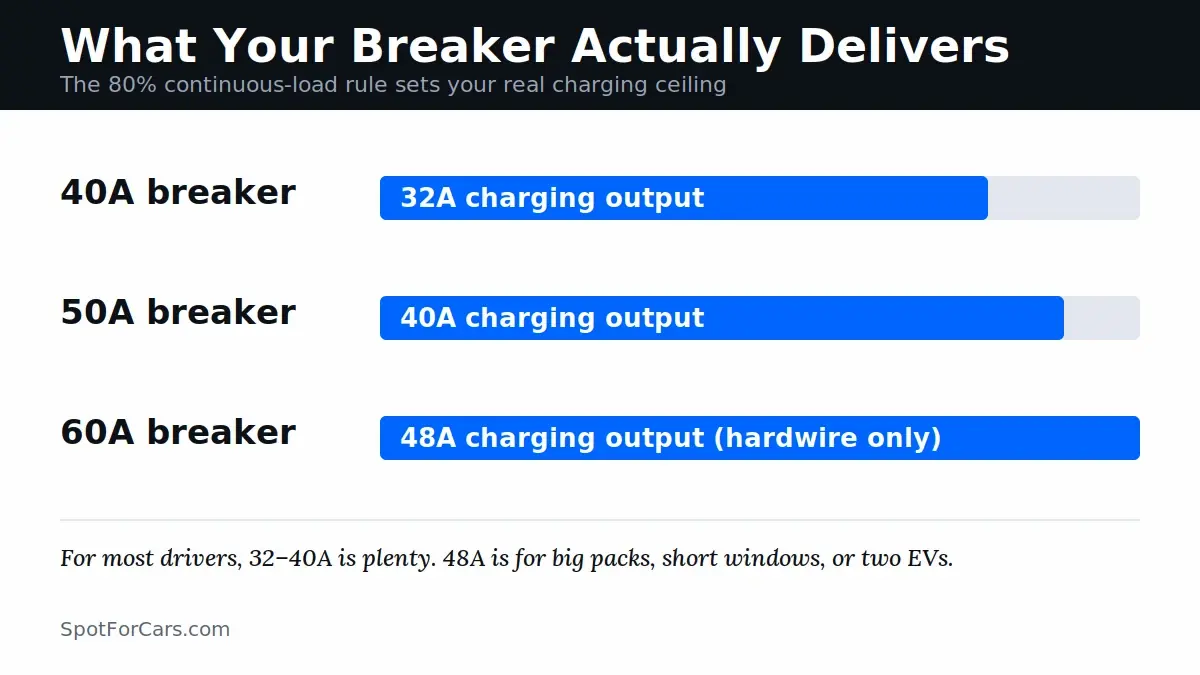
Electrical code limits a charger to 80% of its breaker’s rating for continuous loads. So the breaker behind the charger sets your real ceiling, not the sticker on the box.
| Breaker size | Max continuous charging output | Install type |
|---|---|---|
| 40 amp | 32 amps | Plug-in or hardwired |
| 50 amp | 40 amps | NEMA 14-50 plug-in works here |
| 60 amp | 48 amps | Hardwired only |
The 80% continuous-load rule, matching the official charging table. See the manufacturer breaker-to-output chart here.
Now the part the affiliate roundups won’t tell you. For most drivers, 32 to 40 amps is plenty.
A 40-amp charger adds roughly 30 miles of range an hour. A normal overnight refills almost any commute twice over.
The 48-amp tier earns its keep in three cases: a huge battery pack, a tight overnight window, or two EVs sharing one charger. If none of those is you, paying for 48 amps is buying speed you’ll sleep through.
Don’t take my word for it — run your own numbers below.
Do you actually need 48 amps?
Rough overnight math. Not an install spec — your electrician sizes the circuit.
Should your home EV charger be plug-in or hardwired?
Both can be safe when installed correctly. The choice comes down to your circuit, outlet condition, local code, and how much charging speed you actually need.
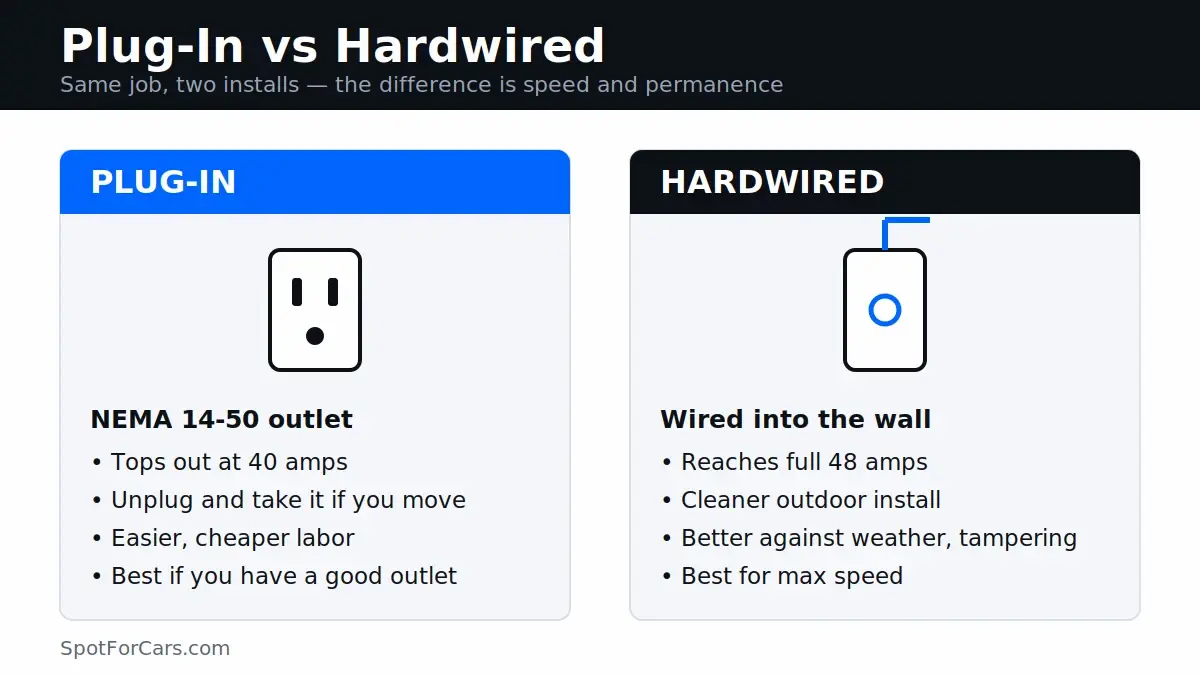
Plug-in means the charger plugs into a NEMA 14-50 outlet, the same one an electric range uses. It tops out at 40 amps, and you can unplug the unit and take it if you move.
Hardwired means the charger is wired straight into the wall. It’s the only way to hit a full 48 amps, and it survives weather and tampering a little better outdoors.
My rule of thumb: if you already have a healthy NEMA 14-50 outlet, go plug-in and save the labor. If you want max speed or a clean outdoor install, hardwire it.
One honesty note on my dryer-outlet story. That old NEMA 10-30 ran two hot legs and a neutral, but had no separate equipment ground.
That’s why a 3-prong dryer outlet needs more caution than a modern NEMA 14-50 or a hardwired install. It can work with the correct listed adapter and a sound circuit, but it is not a grab-any-adapter situation — check breaker size, wire condition, and outlet wear first.
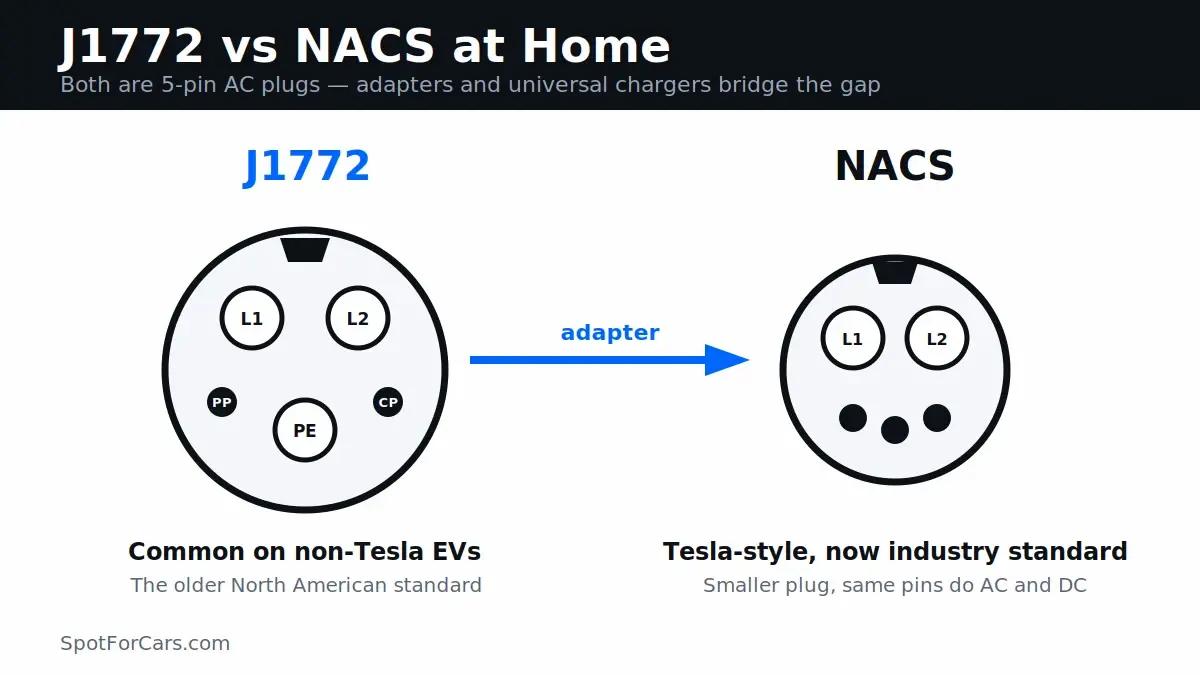
J1772 or NACS — which connector should you future-proof for?
Quick translation. J1772 is the old standard plug on most non-Tesla EVs, and NACS is the Tesla-style plug the whole industry is now adopting.
Here’s the good news: it barely matters for home charging. Most quality chargers now ship in both connector versions, and adapters bridge the gap cheaply either way.
If your household is all Tesla, get the NACS version. If it’s mixed or non-Tesla, get J1772 or a charger with a built-in adapter, and you’re covered for years.
If you’re still fuzzy on the whole charging picture, our guide on how EV charging actually works connects the plugs, the levels, and the speeds.
Which home EV chargers would a mechanic actually recommend?
I’m not going to hand you a top 10. Half of those lists exist to fill affiliate slots, not to help you.
These are the units I’d put on a friend’s wall, sorted by the house they fit. No press loans, no paid placement — just what survives a real buyer filter.
| Charger | Max output | Connector | Install | Best for |
|---|---|---|---|---|
| Tesla Universal Wall Connector | 48A / 11.5 kW | NACS + J1772 | Hardwire | Mixed Tesla households |
| Emporia Pro | 48A / 40A plug-in | J1772 or NACS | Both | Tight or older panels |
| Emporia Classic | 48A / 40A plug-in | J1772 or NACS | Both | Best value |
| ChargePoint Home Flex | Up to 50A / 12 kW | J1772 or NACS | Both | Best app, broad fit |
| Grizzl-E Ultimate | 48A / 11.5 kW | J1772 or NACS | Hardwire | Rugged outdoor |
Best for tight or older panels: Emporia Pro
This is the one I keep coming back to for the readers this guide is built for. The Emporia Pro ships with PowerSmart load management and a Vue energy monitor in the box.
That load management is the trick. It watches your whole-home power draw and throttles the charger so it never overloads a smaller panel — which can save you a panel upgrade on older 100-amp service.
It does 48 amps hardwired or 40 amps on a NEMA 14-50 plug, it’s UL-certified and weather-rated NEMA Type 4, and it has a 3-year warranty. For a healthy 200-amp panel it’s mild overkill, but for a tight one it’s the answer.
This section contains affiliate links. If you buy through them, SpotForCars may earn a commission at no extra cost to you.
If your panel is the bottleneck, the plug-in Emporia Pro is the unit I’d buy.
Best value: Emporia Classic
Same dependable hardware, sharper price. The Emporia Classic drops the included PowerSmart and energy monitor but keeps the build quality.
You still get 48 amps hardwired, a 25-foot cable, an internal GFCI, and a full stack of UL and Energy Star certifications. One correction the spec sheets blur: PowerSmart is a paid add-on here, not standard like it is on the Pro.
For most people with a normal panel, this is the smart-money pick. The plug-in Emporia Classic is the value play I’d point a friend to first.
Best for Tesla and mixed households: Tesla Universal Wall Connector
If anyone in the house drives a Tesla, this is the easy call. The Universal Wall Connector has a built-in J1772 adapter, so it feeds a Tesla and a Ford from the same box.
It’s 48 amps, hardwire-only, and carries a 48-month residential warranty with a roughly 24-foot cable. I recommend it on merit, not as a paid link — there’s no clean affiliate path, and I’m not going to fake one.
Best Tesla-only charger: Tesla Wall Connector
If your garage is Tesla-only and you don’t need J1772 compatibility, the regular Tesla Wall Connector is the cleaner, simpler pick.
It delivers the same 11.5 kW / 48 amps and 48-month residential warranty on a 24-foot cable. If you might add a non-Tesla later, buy the Universal instead.
Best app and broadest fit: ChargePoint Home Flex
The ChargePoint Home Flex is the polished option for someone who wants the best phone app and dialed-in scheduling. It runs up to 50 amps with adjustable amperage from 16 to 50.
It works plug-in or hardwired and comes in J1772 or NACS. It’s not the value pick, but it’s the most flexible box on this list.
Best rugged outdoor unit: Grizzl-E Ultimate
If the charger lives outside and takes abuse, the Grizzl-E Ultimate is built like a tank. It’s a 48-amp hardwired unit in a UL Type 4 cast-aluminum enclosure, made in Canada.
It’s not the smartest box and the app is basic. But for a “mount it and forget it” outdoor install, the toughness is worth it.
What home EV charger should you avoid?
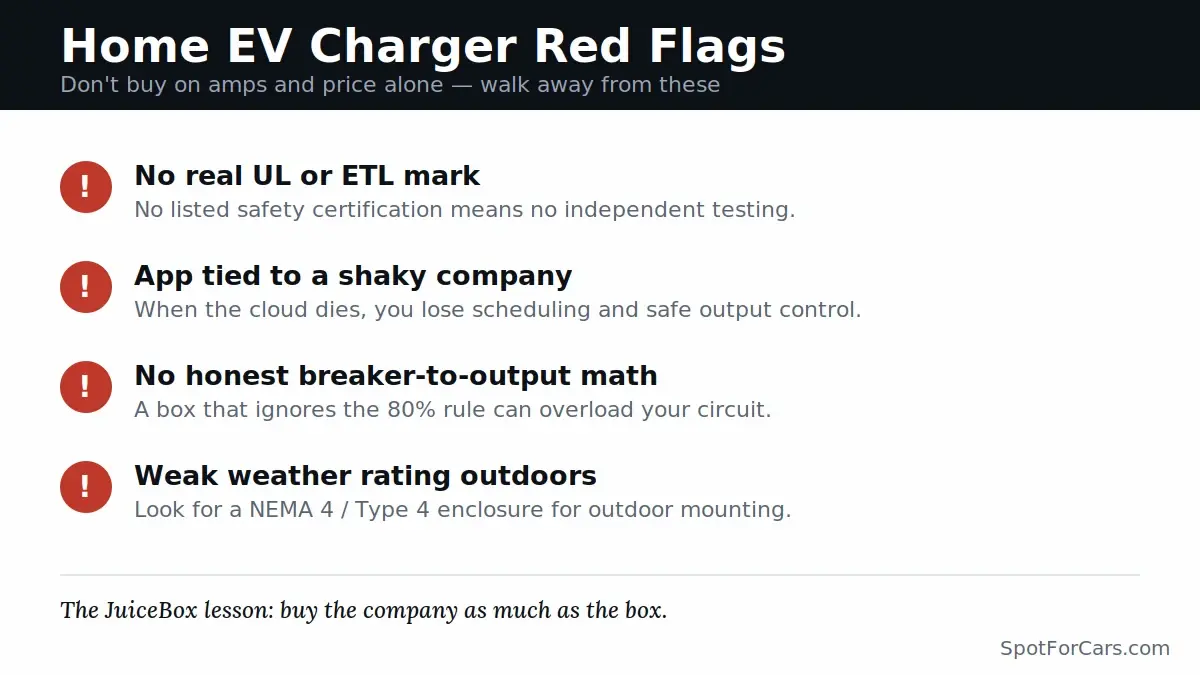
This is the most important section in the guide, and almost nobody leads with it. Don’t buy a charger on amps and price alone.
The cautionary tale is JuiceBox. Its parent company, Enel X Way, shut down its United States and Canada operations in October 2024.
The app died next. Per Consumer Reports, the JuiceBox app stopped working for most owners in July 2025, forcing them onto a third-party workaround just to change a setting.
The part to get right: NHTSA opened a preliminary look into about 180,000 JuiceBox units after fire complaints, including a garage explosion. That investigation was closed in June 2025 with no defect trend found — though a closure is not a ruling that no defect exists.
So the airtight lesson isn’t an active federal probe. It’s simpler and scarier: you can buy a perfectly good charger and have the company vanish out from under it.
When a smart charger’s cloud dies, you can lose scheduling, monitoring, and safe output control overnight. On a 240-volt device, that’s not a software inconvenience.
That’s why I weight certification and company survival heavily. Skip no-name marketplace units with no verifiable UL or ETL mark, no honest breaker math, and a cloud app tied to a shaky brand.
What does installing a home EV charger really cost?
Most guides quote a national range and stop there. Let’s put real numbers on it, including what it looks like here in Florida.
Nationally, a professionally installed Level 2 charger usually runs about $1,200 to $3,000 before incentives. A simple run near the panel lands at the low end; a hard one climbs past it.
Here’s the local angle nobody writes from. In Florida, installs commonly stay under $1,500, thanks to cheaper labor and fewer ancient panels needing upgrades.
Where the bill explodes is the panel and the distance. A 200-amp panel upgrade alone can add $1,500 to $3,000 — sometimes more than the charger itself.
Get two quotes, and make each one answer three things: whether your panel has capacity, how far the wire run is, and whether the permit is included.
Those three answers explain almost every dollar of difference between quotes.
This is also the spot where the Emporia Pro’s load management pays off. Avoiding a panel upgrade can save more than the price gap between any two chargers on this list.
The tax credit clock is ticking — with a catch
There’s still a federal credit on the table, but the deadline moved up. The 30C charger credit covers 30% of hardware and install, up to $1,000, for chargers placed in service through June 30, 2026.
Here’s the catch competitors keep botching. It’s gated to eligible census tracts — low-income or non-urban areas — not every address in America.
Before you assume you’ll get $1,000 back, run your address through the federal 30C eligibility locator. I checked my own Saint Augustine address against the map, and you should check yours.
One more thing people conflate: this is separate from the $7,500 vehicle credit, which ended for purchases after September 30, 2025. The charger credit is the one still alive, and only until summer.
Home EV charger questions, answered
Is a 48-amp home EV charger worth it?
For most drivers, no. A 40-amp charger refills a normal day’s driving overnight with room to spare. Save the 48-amp tier for big battery packs, short charging windows, or two EVs sharing one unit.
Can I charge an EV from a regular dryer outlet?
Sometimes, with the correct listed equipment. An older 3-prong NEMA 10-30 has no separate ground, so it needs caution and a sound circuit. Check breaker size, wire condition, and outlet wear, and confirm your gear is rated for that outlet.
Do I need an electrician to install a home EV charger?
Yes, for a Level 2 charger. It needs a dedicated 240-volt circuit, and many areas require a permit. A licensed electrician keeps it safe and code-compliant.
What’s the difference between a plug-in and hardwired charger?
A plug-in charger uses a NEMA 14-50 outlet and tops out near 40 amps. A hardwired charger is wired into the wall and can reach 48 amps. Plug-in is portable and easier; hardwired is faster and cleaner outdoors.
Which home EV charger lasts the longest?
Look for a real UL or ETL mark, a weatherproof enclosure, and a company likely to still exist in five years. The hardware matters, but so does whether the app and support survive, as JuiceBox owners learned the hard way.
Is it cheaper to charge at home than at a public station?
Almost always. Home electricity usually costs a fraction of public DC fast-charging rates. If you can charge at home, our breakdown of whether an electric car is worth it shows how fast that adds up.
Bottom line: match the charger to your house, not the hype. Sort out your panel and outlet, buy a certified unit from a company that’ll stick around, and skip the amps you’ll never use while you sleep.
Home charging matters even more in a hot climate, where pre-cooling off wall power saves your battery the work. If you’re still picking the car, see my best EVs for hot weather picks.
For the bigger picture on charging speeds and where home charging fits, see how long it takes to charge an EV, and browse the full EV Guide for the rest.